












If your fridge sounds louder than usual, the cause is almost always one of nine things, and most of them you can fix yourself in under ten minutes. The trick is matching the type of noise to the part that produces it.
As a rough reference, many modern domestic refrigerators are rated at around 35–45 dB, roughly the sound of a quiet library.[1] If your fridge sounds noticeably louder than it did when new, or a brand-new noise has appeared, it is worth investigating.
First, know what normal sounds like
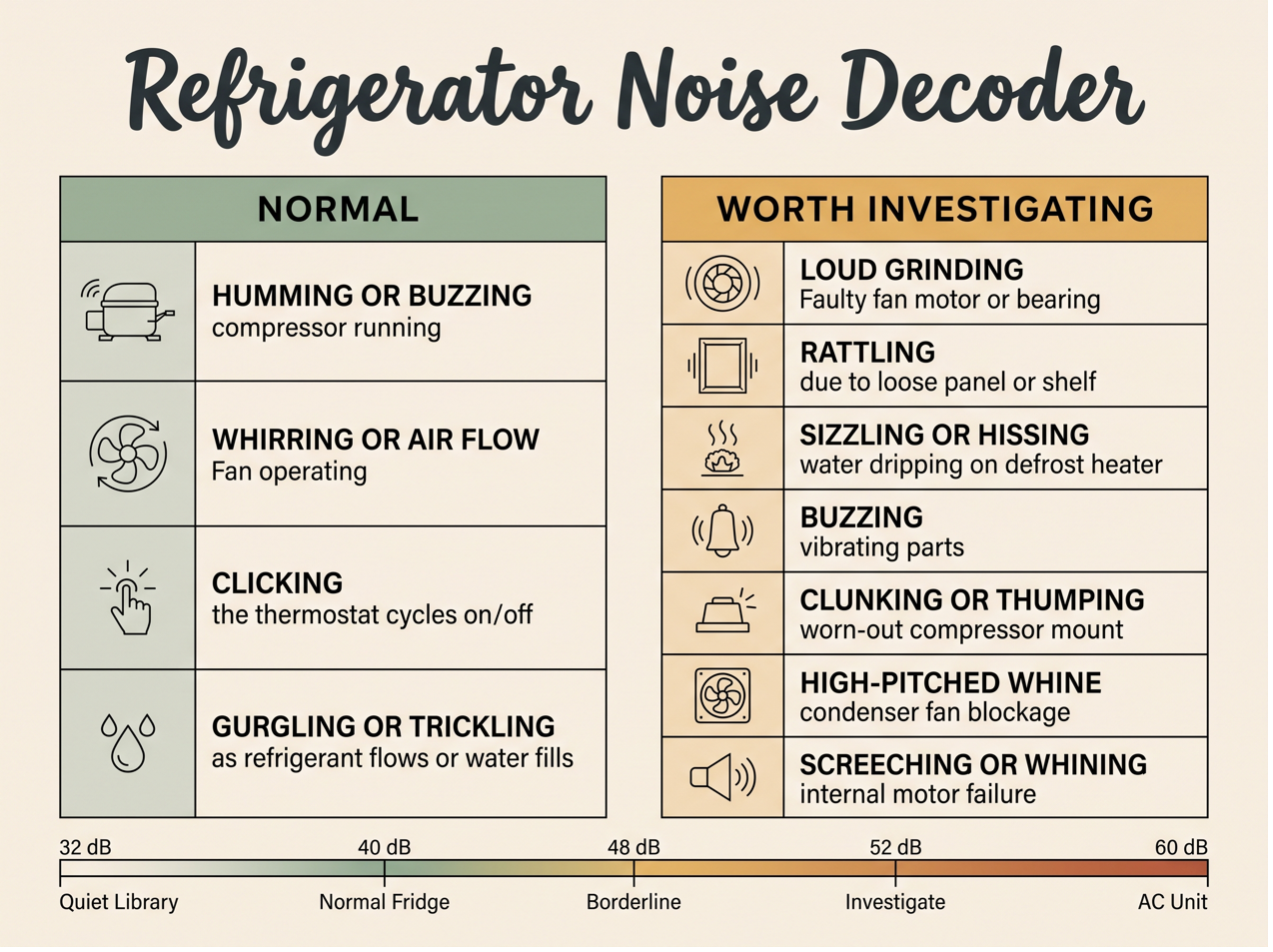
Four sounds are part of the design, not a fault:
A low hum when the compressor cycles on and off
Water trickling during the defrost cycle
Bubbling or gurgling as refrigerant moves through the lines
A steady fan sound from the evaporator fan, or on some models, the condenser fan
Modern variable-speed compressors are even quieter. Inverter compressors typically run between 37 and 40 dB, while older single-speed compressors sit between 40 and 47 dB [2]. That is why a five-year-old fridge often sounds louder than a new one even when nothing is wrong.
How to measure the noise yourself
As a rough reference, many modern domestic refrigerators are rated at around 35–45 dB, with quieter inverter models often closer to the high-30s. A phone app can help you spot changes over time, but it is not a laboratory measurement. The best benchmark is still the rated noise level on your model’s specification sheet, especially if the sound has suddenly become louder, sharper, or more irregular.
Compare the measurement to the original spec sheet for your model if you can find it. Most manufacturers publish the rated dB level. A 5 dB increase from the original rating is the threshold where most appliance technicians recommend a service call.
The 9 abnormal noises and what they mean
1Loud humming or buzzing that wasn’t there before
The compressor is working harder than it should. Three common causes:
- Dust on the condenser coils at the back or bottom of the unit, forcing the compressor to run longer and louder
- The unit is not level, so the compressor mounts vibrate
- The compressor itself is aging
Try the easy fix first. Pull the fridge out, vacuum the coils, and check that the unit is level front-to-back and side-to-side. If the noise persists for more than 24 hours after cleaning, the compressor likely needs service.
2Rapid clicking from the back of the unit
This usually means the start relay is failing or the compressor cannot start. The relay sends power to the compressor; when it fails, you get a click but no compressor hum.
This is not a DIY repair. A failed start relay is a common early warning that the compressor is about to die. Schedule service before the fridge stops cooling entirely.
3Rattling or vibrating
Three things to check:
- The levelling feet. Use a spirit level on the top of the unit. Adjust the front feet up or down until it sits flat.
- Distance from the wall. Rear coils touching the wall transfer vibration directly into the room. Pull the unit at least 5 cm (2 inches) away.
- The condenser fan. If a blade is loose or warped, it rattles against the housing. Unplug the unit and inspect.
4High-pitched squealing or whining
The most common cause is ice buildup on the evaporator fan, which sits behind the back panel of the freezer. The fan blade strikes the ice, and the noise rises in pitch as the fan slows.
Empty the freezer, unplug the unit, and let it defrost for 24 hours. If the squeal returns within a week, the defrost heater or the thermostat that controls it has failed. Both are repairable but require service.
A worn fan motor bearing produces a similar sound. The diagnostic difference: a fan bearing squeals constantly; ice on the fan squeals only when the fan runs.
5Hissing or sizzling
A brief hiss during the defrost cycle is normal. Defrost water drips onto the heater element, and the heat flashes the water to steam. This happens once or twice per cycle and lasts a few seconds.
Safety warning
A continuous hiss is different. It can mean a refrigerant leak, especially if it is paired with the fridge running constantly but failing to cool. Stop using the unit and call service. R600a, the refrigerant in most modern domestic fridges, is flammable in concentration.
6Knocking or banging
Two normal causes and one warning sign:
- The ice maker dropping cubes into the bin produces a single bang every 1 to 2 hours when the ice maker is on. Switch the ice maker off for a day to confirm.
- The compressor cycling on can produce a knock as the rubber mounts settle.
- Continuous banging during compressor operation suggests the internal mounts have failed. The compressor is moving inside its housing. This requires service.
7Popping or cracking
Plastic interior liners expand and contract as the temperature shifts during defrost cycles, producing pops and cracks. This is normal and especially common in summer or right after the unit defrosts. No action needed.
8Gurgling or bubbling
Refrigerant moving through the capillary tube between the condenser and the evaporator coil produces this sound. It is the sound the cooling system is supposed to make. No action needed.
9Grinding
The most serious sound on the list. Grinding indicates either a damaged condenser fan blade or internal compressor wear. The metal-on-metal contact will accelerate failure. Schedule service immediately and consider whether the unit is worth repairing rather than replacing, especially if it is over 10 years old.
The 5-minute check that catches most issues
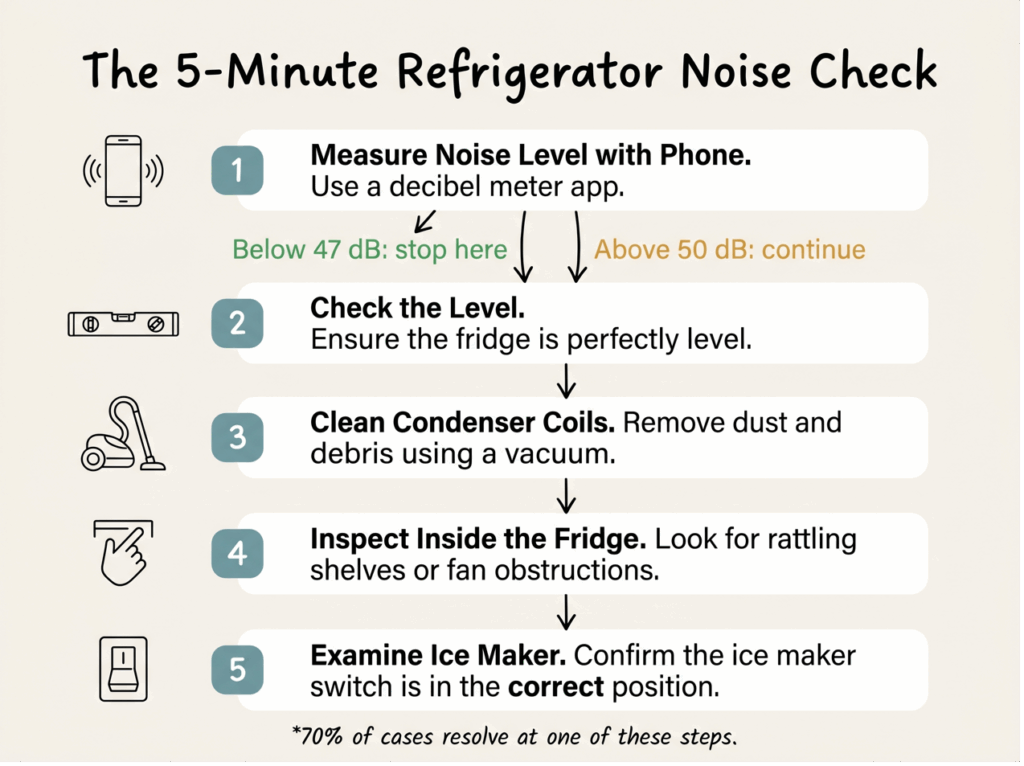
Run through this sequence before calling for service:
- 1Measure.
Decibel reading at two feet from the front, averaged over 30 seconds. - 2Level.
Spirit level across the top, both directions. - 3Coils.
Pull the unit out, vacuum the coils at the back or bottom. - 4Inside.
Look for vibrating items. A bottle resting against the glass shelf, a can rolling against another can, and an unsecured ice maker tray are all common culprits. - 5Ice maker.
Switch it off for 24 hours and listen again.
Result
About 70 percent of noise complaints resolve at one of these five steps without a service call.
Why modern No-Frost refrigerators are quieter
Variable-speed (inverter) compressors do not cycle the way older single-speed compressors do. Instead of clicking on at full power and shutting off when the target temperature is reached, they run continuously at low speed and adjust output to demand.
The result is two-fold. Peak noise is 7 to 10 dB lower than a single-speed compressor [2]. And the audible click of cycling on and off is eliminated. A 7 dB reduction roughly halves the perceived loudness.
If your current fridge is over 10 years old and uses a single-speed compressor, the next replacement will probably be noticeably quieter even before you compare rated dB numbers. Selected Homa Combi-No-Frost models use variable-speed compressors.
When the answer is replace, not repair
Three situations where repair stops making sense:
The compressor repair quote exceeds 50 percent of a new unit’s price
The unit is over 10 years old
The unit has a refrigerant leak and uses R134a, which is being phased down under the EU F-Gas Regulation and the US AIM Act, making refills increasingly expensive
The replacement decision is covered in detail in our companion guide on signs your fridge needs replacing.
FAQs
Is it normal for my fridge to be loud when it first starts?
Yes. The first 30 to 60 seconds after a compressor cycles on are louder than steady-state operation. If the loud noise continues past 2 minutes, that is when to investigate.
Should I unplug a noisy refrigerator until it is fixed?
Only if the noise is grinding, continuous hissing (possible refrigerant leak), or if the unit smells of burning. Most other noises do not require unplugging.
How loud is too loud in decibels?
There is no single dB threshold that applies to every model. The best reference is the rated noise level on your model’s specification sheet. If the sound is noticeably louder, sharper, or more irregular than normal for your unit, it is worth investigating.
Can a dirty condenser really cause noise?
Yes. Dust insulates the coils, which forces the compressor to run longer to remove heat. Longer run time at higher load produces more noise and more heat. The fix is a 15-minute vacuum of the coils every six months.
How long does a refrigerator compressor last?
The compressor is usually the longest-lived component, often outlasting other parts by a wide margin. Consumer Reports finds members typically expect 10 years of service from the unit as a whole [3]. A failing compressor before year 7 is unusual.
If your fridge is otherwise in good shape but has aged into a higher noise range, replacing the entire unit usually makes more sense than replacing the compressor alone. Newer units run quieter from day one.
References
[1] Ancaster Food Equipment. “How to Make a Commercial Refrigerator Quieter.” Ancaster Food Equipment Blog, 24 Sep. 2024, https://www.ancasterfoodequipment.com/blog/how-to-make-a-commercial-refrigerator-quieter/. Accessed 9 May 2026.
[2] Expert Appliance. “What Your Refrigerator’s Noises Are Telling You.” Expert Appliance, https://www.expertapplianceinc.com/what-your-refrigerators-noises-are-telling-you/. Accessed 9 May 2026.
[3] Consumer Reports. “How to Make Your Refrigerator Last Longer.” Consumer Reports, 26 Jun. 2022, https://www.consumerreports.org/appliances/refrigerators/how-to-make-your-refrigerator-last-longer-a3675077642/. Accessed 9 May 2026.