












Most fridge waste comes from one mistake: guessing instead of checking. Americans throw out 30 to 40 percent of the food they buy, and the average family of four loses around $1,500 a year to uneaten groceries [1]. A printable chart on the fridge door fixes most of that.
This guide pulls every category from the FDA Refrigerator and Freezer Storage Chart and the USDA Food Safety and Inspection Service into a single reference, with a few practical notes on why the numbers are what they are. Use it as your kitchen’s source of truth.
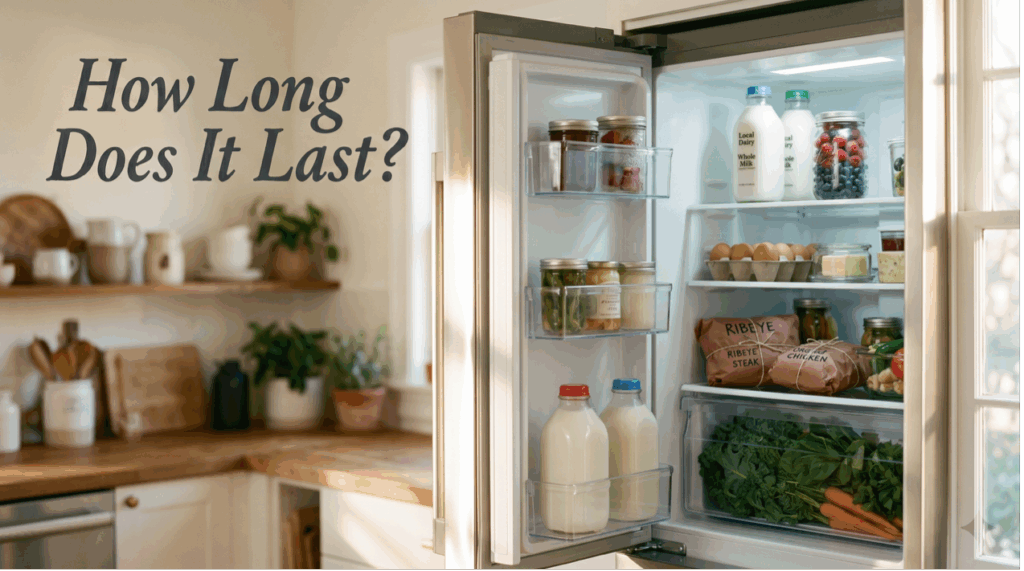
The two rules that make every number on the chart work
Before any specific timeline applies, two conditions have to be true.
Keep the fridge at 40°F (4°C) or below
The USDA defines anything between 40°F and 140°F (4°C and 60°C) as the “Danger Zone,” where bacteria can double in number in as little as 20 minutes [2]. A fridge running above 40°F can shorten safe storage times and increase food-safety risk.
Store food in the cold part of the fridge
The door is the warmest zone, sometimes 5°F warmer than the back shelf. Milk, eggs, and meat belong on interior shelves, not in door bins. The FDA chart specifically warns to “keep meat and poultry in its package until just before using” [3].
The complete refrigerator food storage chart
The numbers below come directly from the FDA Refrigerator and Freezer Storage Chart [3]. Where the FDA gives a range, the range is preserved, not averaged.
Eggs and egg products
A frequent question: are eggs still good after three weeks? Yes, if they have been refrigerated continuously and are still inside the FDA’s 3 to 5 week window. The float test (an egg that floats in water has lost mass to evaporation and is past its prime) is a useful backup check.
Raw meat, poultry, and ground meat
Ground meat spoils faster than whole cuts because grinding exposes more surface area to bacteria. The 1 to 2 day window applies whether you bought it Tuesday or Wednesday; storage time runs from purchase, not from the sell-by date.
Cured and processed meat
Fish and shellfish
Cooked leftovers
The four-day rule for cooked leftovers is a hard ceiling, not a guideline. After day four, the USDA recommends discarding even leftovers that look fine [4].
Deli and prepared foods
Pre-stuffed raw meat has the shortest fresh shelf life on the chart at one day. The stuffing creates a warm interior cavity that is slow to cool to 40°F and provides ideal conditions for bacterial growth.
A note on freezer times: those numbers are about quality, not safety
The FDA chart includes a critical note that gets lost in most online food storage advice. Frozen food at 0°F (-18°C) stays safe indefinitely. The freezer times in every column above are quality timelines, not safety deadlines [3].
A steak frozen for 18 months will not poison you. It may have freezer burn, dry spots, or off flavours, and it probably will not taste as good as a steak frozen for 6 months. But it is safe to cook and eat.
This matters for the common question, “does freezing restart the clock on shelf life?” The answer is no — freezing pauses the clock. When the food thaws, it returns to the refrigerator timeline that applied when it was frozen. Thawed ground beef gets 1 to 2 days in the fridge, the same as fresh.
How to tell if food has gone bad
The chart gives you a deadline. Your senses give you a final check.
Look for slime on the surface of meat or deli items, dulled or greyish colour, mould spots, and bulging packaging. Smell for sour, sulphur, or ammonia notes. The “when in doubt, throw it out” rule from USDA FSIS is not a slogan, it is the conservative position [4]. A few dollars of food costs less than a foodborne illness.
Some bacteria, especially Staphylococcus aureus and Clostridium botulinum, produce toxins that survive cooking and have no smell or visual signal [2]. Sensory checks catch most spoilage but cannot catch all of it. The chart matters because it accounts for what you cannot see.
Five habits that help food stay fresh for longer
- 1Run the fridge at 1 to 3°C / 34 to 37°F instead of the default 4°C / 40°F.
Keeping the fridge a few degrees below the Danger Zone threshold helps food stay fresh longer. A second appliance thermometer on the back shelf is worth the $5 it costs. - 2Store by zone.
Raw meat goes on the bottom shelf, where leaks cannot drip onto produce. Dairy and eggs go on interior middle shelves, not the door. Crisper drawers handle produce. The USDA FSIS notes that crisper drawers are designed with humidity control specifically for this purpose [4]. - 3Move leftovers into airtight containers, not original packaging.
Original packaging is designed for transport, not storage. - 4Refrigerate within 2 hours of cooking or purchase.
Cut the window to 1 hour if outdoor temperature is above 90°F (32°C). This is a USDA rule, not a recommendation [2]. - 5Portion leftovers into shallow containers.
A 4-inch deep container of soup takes hours for the centre to cool below 40°F. The same volume in a 1-inch deep tray cools in about 30 minutes. The middle of a slow-cooling container sits in the Danger Zone the entire time.
Refrigerator features that meaningfully extend shelf life
Three features matter more than the rest:
Humidity-controlled crispers
Set high humidity for leafy greens (which wilt as they lose moisture) and low humidity for stone fruit and apples (which spoil faster as they release ethylene gas). The USDA FSIS confirms produce drawers are most useful when humidity is matched to the contents [4].
Multi-zone cooling
Separate compartments stay at different temperatures. Meat in a sub-zero compartment, vegetables at 4°C, and beverages at the door can all be optimal at once.
Multi-airflow systems
Cold air is distributed evenly so the back shelf and the front shelf are within 1°C of each other. Without it, food at the front cycles in and out of the Danger Zone every time the door opens.
Homa’s Multi-Door range is built around these three features, with dedicated chiller and crisper zones. The Combi-No-Frost series covers the same humidity and airflow design at a smaller footprint.
FAQs
Can I eat food past the “use by” date if it looks fine?
Use-by and best-by dates are quality dates set by manufacturers, not federal safety dates [1]. The exception is infant formula, where the use-by date is regulated. For everything else, the USDA storage chart is a more reliable guide than the printed date.
Does freezing restart the clock on shelf life?
No. Freezing pauses the clock. Thawed food picks up the refrigerator timeline that applied before it was frozen.
How long does cooked rice last in the fridge?
Three to four days, the same as other cooked leftovers. Cooked rice is associated with Bacillus cereus food poisoning when left at room temperature, so the 2-hour rule matters here in particular.
Are eggs still good after 3 weeks?
Yes. The FDA range is 3 to 5 weeks for fresh eggs in shell, kept refrigerated [3].
How long can I keep thawed meat in the fridge before cooking?
One to two days for ground meat, poultry, and fish. Three to five days for steaks, roasts, and chops. The same as fresh.
Why does the FDA chart not list every food?
Items not on the chart (most condiments, jams, opened nut butters, plant-based milks) follow manufacturer guidance on the label. When in doubt, the standard 7-day rule for opened refrigerated items is a safe default.
A printable version of this chart is in the works. In the meantime, bookmark this page on your phone for the grocery aisle.
References
[1] U.S. Department of Agriculture. “Food Loss and Waste.” USDA, https://www.usda.gov/about-food/food-safety/food-loss-and-waste. Accessed 9 May 2026.
[2] U.S. Department of Agriculture, Food Safety and Inspection Service. “‘Danger Zone’ (40°F – 140°F).” FSIS, https://www.fsis.usda.gov/food-safety/safe-food-handling-and-preparation/food-safety-basics/danger-zone-40f-140f. Accessed 9 May 2026.
[3] U.S. Food and Drug Administration. Refrigerator and Freezer Storage Chart. FDA, March 2018, https://www.fda.gov/media/74435/download.
[4] U.S. Department of Agriculture, Food Safety and Inspection Service. “Refrigeration and Food Safety.” FSIS, https://www.fsis.usda.gov/food-safety/safe-food-handling-and-preparation/food-safety-basics/refrigeration. Accessed 9 May 2026.