












A conversation with Italian designer Lorenzo Damiani on the design of surprise, poetry of form, folding marble and other wonders.
What happens when marble bends, chipboard gains dignity, and rainbows appear without a storm? In the eyes, and hands, of Lorenzo Damiani, design stops being about noise and novelty and becomes a quiet act of intelligence. With the mind of an inventor and the ethics of a craftsman, Damiani reshapes familiar materials into unexpected forms, always guided by a deeper sense of purpose. His work, at once poetic and precise, reminds us that true innovation often lies in restraint, and that good design is not only what lasts, but what speaks. Lorenzo Damiani shares his perspectives on design, its functions and responsibilities.
What guides your work today, and what legacy would you like to leave for young designers?
I believe that the most important goal, in life as in design, is to seek the meaning of things and of our actions. As I always say, before designing anything, one must understand the reason for doing it, carefully considering all possible variables. Everything we create today will outlive us tomorrow, often for a very long time, and may become a burdensome legacy for future generations.
I would like to pass on to younger designers a strong understanding of the value of research in design: in-depth study, perseverance, and the necessary effort to reach a goal, the ability and strength to overcome the disappointments that will perhaps be numerous. Above all, I hope to convey that it is possible to work with great passion without needing to take shortcuts; social media is not real life.
What do you think needs to be designed into the current international design landscape with an eye to the future?
The real world needs practical design responses that overcome issues like early obsolescence, where adjusting a component is always possible, where purchasing a regenerated object is normal, where the idea of ‘fast design’ diminishes, and where we limit the idea of possession and ownership, replacing it with sharing and usage. Not to have but to use when needed: this approach, already taking hold in certain areas, deserves to be spread like wildfire.
“We already have more than we need. Maybe the most responsible act is to create less.”
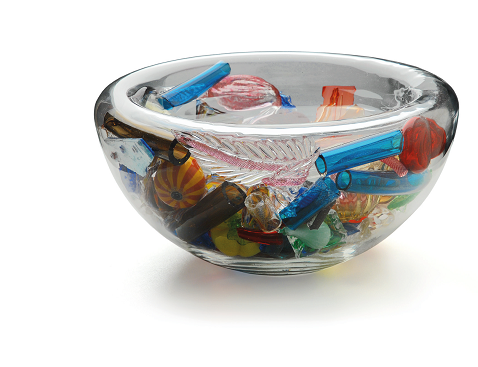
152 collection
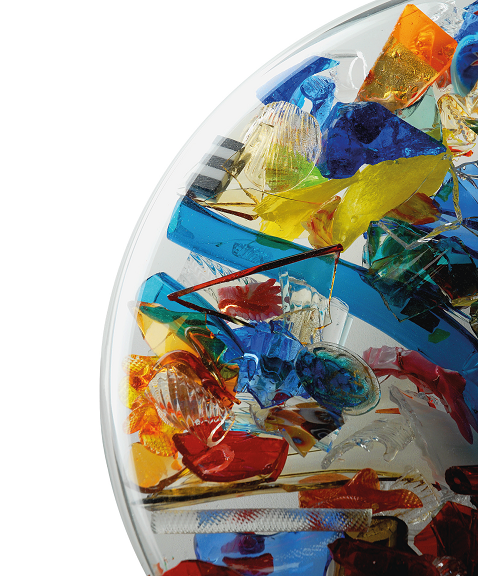
Glass waste is placed in a special container that has a tube and then sealed permanently. The collection is produced by Luigi Fornasier on the Venetian island of Murano
What is, what represents, and how important is regenerative design?
Considering the impact of our design actions, as I said before, I think it is fundamental. We live in a system in constant evolution that also feeds on what we do to regenerate itself and, therefore, we must always think about the consequences of our ‘doing’. Personally, I prefer the label ‘common sense design’ to ‘regenerative design’. In a world in which we now have more than enough of the superfluous, perhaps the fairest action would be to minimise new productions or, in any case, try to act with extreme responsibility. The world is ours, but it will also be of those to come.
What results, what perspectives has your research on the extreme performance of materials, on their “breaking point”, brought?
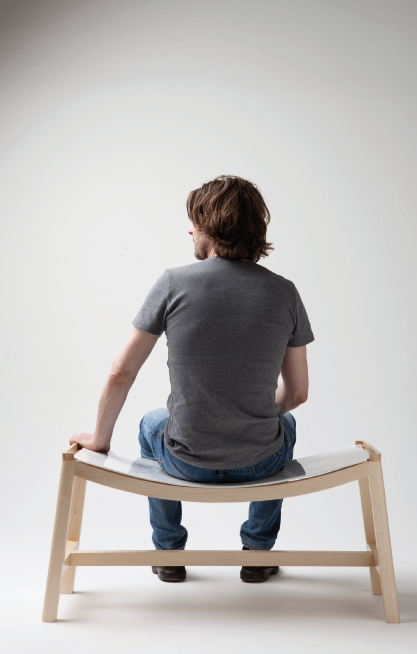
I want to answer this question by giving the example of my experience with marble. In 2007 I started to use thin sawn marble but, only from 2012, I was fortunate enough to understand that this semi-finished stone could be used in an alternative way. In fact, before that moment, the thin slabs have always been used flat: I have simply transformed a technical limit into a design opportunity, coming to understand how to exploit the defect of flexibility – due to their being so thin – to create marble objects that before this research could only be obtained by milling a block. So, my solution has allowed to save a lot of material: this has always been the real goal. Then, from the experience gained through projects in “bent marble” we got to the extreme of the “foldable marble” with the Foglio bench, in which the thin slab of marble flexes under the weight of the person itself. Obviously, to get to this result, we had to do a lot of research to know what the exact breaking point of marble was… even if the project does not exclude that this may occur after a certain number of interactions.
How does your statement “the communication of a message can be considered the main purpose of an object” materialise?
Many of my projects carry a more or less explicit message. For example, if I think about the Truciolari collection… the idea underlying the entire collection is that any material, if well crafted, can become precious. So, in order to convey this idea, I tried to tie chipboard, a widely known and used semi-finished material, to equally established techniques like manual turning and CNC milling. This process gave rise to “other” kinds of objects, conferring a new dignity on chipboard itself. The idea is precisely to show how interesting and original results can be achieved even with materials perceived as poor or less noble.
Or take the Earth Overshoot Day collection, where the message becomes even more evident: I tried to visualise the consumption of our planet’s non-renewable resources through the erosion of a world map. To tell the story of this alarming depletion, I created CNC-milled vases, finished by hand using scraps of cedar veneer. It seems clear to me that the real function of these vases is their message.
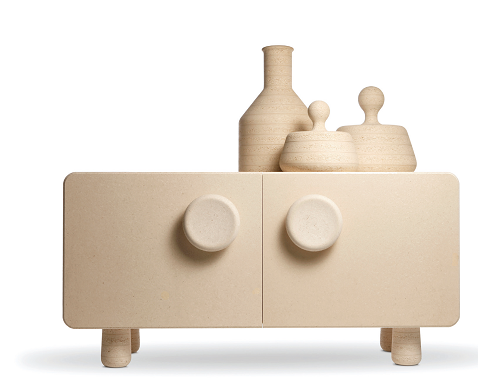
Truciolari Collection
A new, nobler life for poplar chipboard — hand-shaped or CNC-milled, left raw and finished with a water-based coating that preserves its natural essence. Fully recyclable.
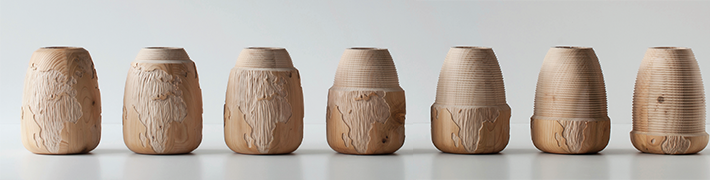
Earth Overshoot Day Collection Mobilitaly
This project traces key dates of World Overshoot Day, revealing humanity’s escalating overuse of Earth’s resources from 1986 to projections for 2045. A stark reminder of what lies ahead, unless our relationship with the planet changes.
What do you think about the current trends of geo-cultural design and neurodesign?
I definitely feel close to a design approach that takes into account the relationship with the places where the object itself originates, but I don’t feel the need to attach a “label” to this attitude. I believe that the measure by which a project should be judged is its quality; everything else seems secondary to me.
“The real function of some objects is the message they carry.”
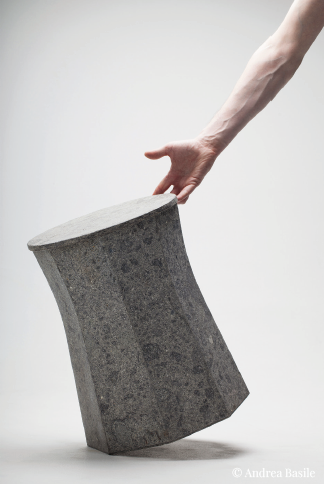
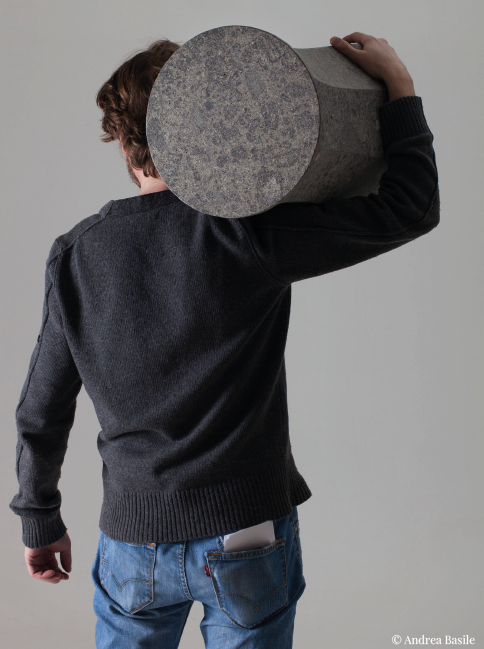
Marmo Piegato – Stool – Pusterla Marmi
Crafted from a thin marble sheet delicately bent, it reveals how stone can take on light, sinuous forms through innovative techniques, reducing material waste while challenging marble’s traditional rigidity.
What is your definition of “empathetic design“, is it a response to a certain cultural evolution or a necessity that has always existed but is now explicit?
Personally I don’t feel very comfortable with this definition. I consider it redundant, unnecessary, and I wouldn’t want my projects to be defined as such. To me it is totally obvious that users’ needs, be they direct or indirect, should always be at the centre of the project.
If the concept of “surprise” is your signature style – new unexpected powers to things, like the table/fan, the armchair/suitcase and many others – do you consider yourself more an inventor than a designer?
In 2009, for the solo exhibition “Lorenzo Damiani: Where Have All the Inventors Gone?” at the Triennale di Milano, curator Marco Romanelli highlighted my inclination to work on the fusion of functions, a kind of typological contraction, viewing form as the result of a more complex thought process. Later on, Silvana Annicchiarico described my design approach as a “design of surprise,” specifically to underline the sense of wonder and disorientation that some of my projects may evoke when seen for the first time. That said, I consider myself a designer.
What role can technology and in particular artificial intelligence have for a design that wants to remain “human”?
Artificial intelligence, if used properly by individuals with a certain level of experience, could certainly become a valuable aid. The problem arises when this tool is used by designers who exploit the opportunity in a superficial way, risking the homogenisation of ideas.
“Surprise and disorientation can be part of a project’s language.”
Your work “Rainbow Without a Storm” is an example of visual poetry: what role does the poetic dimension have in your design?
To be honest, I find it a bit difficult to answer this question. For me, every project must respond to a set of questions. The way those answers are given can vary depending on the context, although there are likely to be some recurring elements that might be interpreted as a form of design poetry. I would rather share with you the secret of how to create rainbows: this project aimed to reproduce the colours of the solar spectrum in a natural way and in a carefully selected location, seeking to trigger the formation of an authentic, non-artificial rainbow. The aim was to preserve the poetic quality of light refraction, subjected to the laws of Nature which alter the chromatic effects according to the changing brightness of the day. All of this is Rainbow Without a Storm.
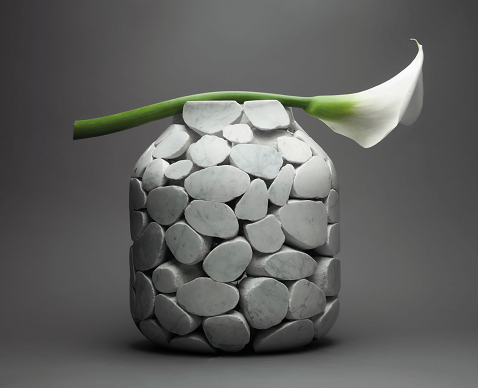
Boboli – Pusterla Marmi
Marble pebbles, typically used in landscaping, are bonded and CNC-milled to create sculptural forms. Between each stone: only air and a hidden glass tube to hold water.
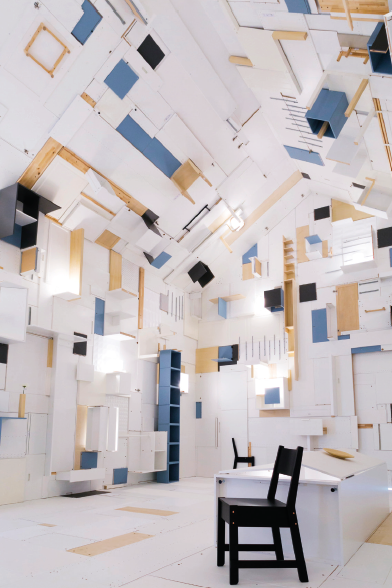
Ikea – Fuorisalone 2018 – ‘Alla Scoperta Dell’infinito’Disassembled furnishings suggest endless possibilities, reflecting a flexible, ever-evolving way of living.
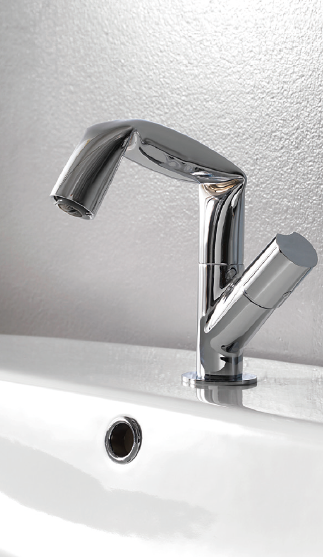
Fold – Ceramica Flaminia external folds become internal barriers, slowing water flow and reducing pressure.
Lorenzo Damiani
BIO
Lorenzo Damiani (b. 1972, Lissone /near Milan) is an Italian furniture and product designer with a degree in Architecture from Politecnico di Milano. His work is rooted in a sustainable, material-driven approach. He has notably been experimenting with marble and metal to minimise waste and maximise structural efficiency. Significant projects include the Aerea and Benna benches (Da A), the Monolithos, Marmo Leggero, and Boboli marble collections.
Marmo Pieghevole – Panca Foglio
Copyright © Homa 2026
All rights reserved