












A conversation with Marco Baldocchi on neurodesign, emotional resonance and how empathy and emotion shape the choices we think we make.
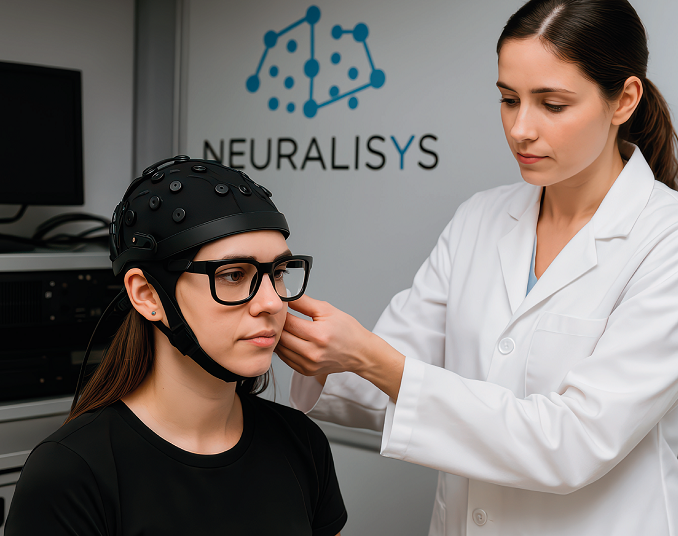
Neurotesting packaging — In 2024, Neuralisys measured how different on-pack messages for a functional beverage shaped consumers’ neurological and behavioral responses.
What makes a product not just beautiful, but meaningful? For Marco Baldocchi, design thinker and specialist in neuromarketing, the answer lies in resonance: the subtle emotional vibration a product triggers in the mind of the beholder. In this wide-ranging conversation, he breaks down the science and emotion behind empathetic design, shares real-world insights from cross-cultural research, and argues for a shift in design thinking from aesthetics to significance. From symmetrical pasta to misunderstood packaging, Baldocchi reveals how deep listening, neuroscience, and cultural awareness are reshaping the relationship between people and products.
What makes a product truly empathetic? How does it go beyond mere aesthetic appeal?
Well, design starts with something that pleases the eye. It stimulates the visual sense, which is one of our most dominant senses. In fact, around 55 percent of our neurons are dedicated to processing visual information. So of course, design first connects through vision and activates our brain. But from there, it goes deeper.
When a product manages to stimulate the limbic system, the part of the brain connected to emotions, it can establish a genuine connection. Empathy happens when the consumer recognises the product as something that speaks to them, or even for them. That moment of unconscious recognition between the user and the object creates a meaningful relationship.
This recognition might come from evoking a memory, a sensation, or shared values. For example, if someone strongly values sustainability, even the tactile sensation of a material that feels eco-friendly can create a connection, even if, paradoxically, the material is not sustainable. It’s the perception that counts.
You talk a lot about emotional resonance in design. Could you elaborate on what that means?
I believe that the keyword in empathetic design is resonance. When an object, product, sound or taste resonates with someone’s emotional memory, it creates a bond. Through the senses, it triggers an emotion, and that emotion fixes a memory. That’s how an authentic relationship is formed. It’s not about targeting people’s senses, it’s about vibrating with something they already carry inside.
That’s why I prefer to speak of an interior echo rather than just aesthetics. Empathetic design should not just be about what looks good, but what leaves an imprint.
What are the key factors that create this resonance?
Over time, I’ve identified five main factors: familiarity, trust, desirability, consistency, and meaning. These form a kind of emotional archetype that can be found across cultures. Of course, socio-cultural factors influence everything. But within certain clusters of people, there are patterns that are surprisingly consistent.
Neuroscience gives us qualitative tools to observe this. You don’t need huge numbers. Around 30 well-clustered participants can yield scientifi cally valid insights. With the right sample, we can detect common emotional reactions, facial expressions, subconscious responses.
And we must remember: the unconscious mind reacts 200,000 times faster than the conscious mind. That’s why it’s so crucial to pay attention to unconscious perception. The first impression happens before you are even aware of it.

Visual maps show where consumers’ attention lingers on a shelf, uncovering unconscious patterns that influence choice.
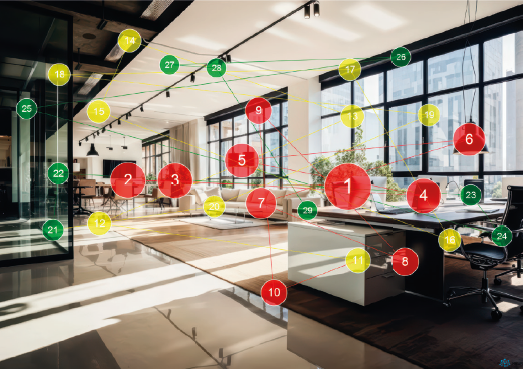
Neuroscience meets architecture — Using platforms like iMotions, researchers can track eye movements, facial expressions, and biometric signals to reveal how office design unconsciously shapes focus, comfort, and emotional engagement
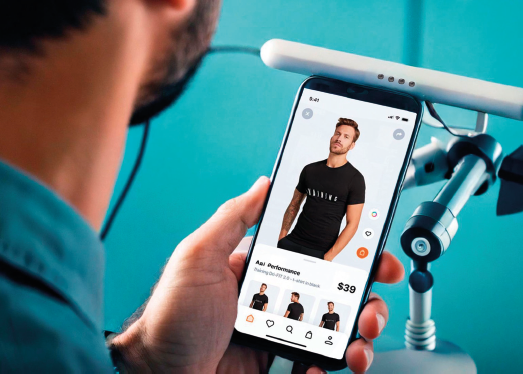
Eye-tracking technology helps researchers understand how users navigate digital interfaces, revealing where focus falls and how design choices guide behaviour
We are animals that are emotional, lazy and selfish. It sounds bad when describing the human being like that, but it’s true. Without emotion you don’t create attention, and if there’s no attention, there’s no choice. Then, ultimately, the rational part of our brain is engaged. That’s why often the simplest designs are the most successful, since they involve less cognitive load.
This is exactly why designers must shift their attention from form to meaning. You are not decorating an object, you are embedding a story. And that story must resonate emotionally first.
“When an object resonates with someone’s emotional memory, it creates a bond”

Psychologist Paul Ekman, a pioneer in the science of emotions, developed the Facial Action Coding System (FACS) to decode the micro-expressions that flash across our faces in fractions of a second.
These subtle, involuntary movements reveal emotions we may not even be aware of—shaping trust, empathy, and decision-making long before rational thought comes into play.
So, how does this play out across different markets?
This is where it gets really interesting. I often work with brands that want to enter the American market. They bring products that perform strongly in their home country but then face a completely different perception abroad. I recently did the reverse, helping a US company enter Europe. Their managers struggled to understand why things that were essential for them made no sense here.
Take colours. In China, red symbolises prosperity. In Italy, it means passion. Or consider minimalism. A minimalist, natural product with soft pastel packaging might work beautifully in some European countries, but flop in the US. There, it might need bolder, more vibrant colours.
On the other hand, try selling a fluorescent product in Europe, no chance.
We have biological constants like symmetry, which universally pleases the brain. The association between beautiful and good is another strong stereotype, neurologically ingrained. But many other responses are built culturally.
And these differences go deep. Even gestures, even facial expressions can carry different meanings. In some cultures, smiling is a signal of trust. In others, it might mean submission. So empathy in design has to include cultural empathy too.
Can you share a practical example of this cultural mismatch?
Absolutely. We ran a research project for an Italian food brand targeting the US. We tested in Los Angeles, Dallas, and New York. The results were eye-opening. In Dallas, for example, many people didn’t even know what an artichoke was, even among high-spending, well-travelled consumers. So, forget selling artichokes there.
Even more striking: grissini with pizza flavour. You’d think that combining two American favourites, breadsticks and pizza, would be a win. But they didn’t sell.
There’s no mental association between those flavours in the US market.
Then there was the tomato sauce. A runnier sauce triggered disgust reactions in facial coding. The gesture of turning over the bottle and seeing it so liquid made people recoil. The same product, but with visible tomato pulp, was perceived as fantastic.
Did you notice any patterns in terms of perceived value?
Oh yes. One example blew me away. A packet of coloured farfalle pasta, all naturally dyed, with a transparent design-led package. The company wanted to sell it at 3 dollars. But in unconscious price perception tests, consumers in all three cities placed its value at 9 dollars. That’s three times more.
And these were consistent results across very different regions. That shows the power of design. If you create something visually compelling, with the right emotional cues, it significantly boosts perceived value.
How do you bridge the gap between academic research and real-world business?
That’s something I care about a lot. Universities are amazing labs, but they can take six months to deliver research results. Businesses don’t have that kind of time. In my work, we deliver insights in a month, concrete, actionable, without the heavy theory. For example, we might tell a brand: change the packaging like this, focus your marketing on that message.
My goal is to make science practical. If it stays abstract, it’s beautiful, but inaccessible.
When you speak to companies, what do you often find is missing in their understanding of design?
Many brands start by saying: “My customer doesn’t understand me.” But over time, they realise they need to communicate differently. They talk about “hitting the target” or “impacting the senses.” I always stop them. You don’t need to hit anyone. You need to make something resonate.
That’s the big shift. Don’t ask what your product means to you. Ask what it means to your audience. The same product means different things in different countries. So adapt the story. Make sure it aligns with local perceptions and emotional expectations.
What would you say to designers focused only on the rational or functional aspects of a product?
“We have this illusion that people decide rationally, but it’s emotion that triggers interest. Rationality comes later, to justify the choice”
If you want to influence choice, you must first create attention. And to do that, you need to work on emotion. Without that, even the most functional, brilliant product might never be noticed.
We have this illusion that people decide rationally, but it’s emotion that triggers interest. Rationality comes later, to justify the choice. The product that evokes a feeling first will always win the battle for attention.
And I want to say something more: if you design only with logic, you may create something correct, but not something that lives. Products, like people, need a soul. That soul is emotion.
Any final thoughts on where empathetic design is heading?
I believe we need to move from a focus on form and function to a focus on meaning. Empathy in design is not about making something attractive. It’s about creating a shared emotional vibration. That’s where real value lies.
Ultimately, it’s about resonance. If you can trigger the right emotional memory, if your product can echo something deep inside the user, then you’ve done your job as a designer.
Empathetic design does not mean making something nice. It means being able to put yourself in the shoes of your audience, in their daily lives, with their cultural and emotional baggage. It means creating something that speaks their language, without words.
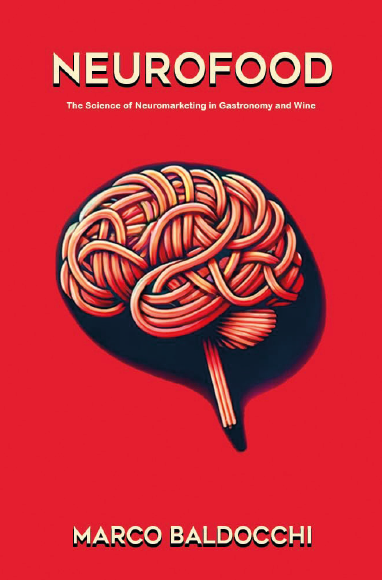
Neurofood (Hoepli, 2022) Baldocchi’s book explores how our brain reacts to food, from everyday choices to immersive dining experiences, revealing the hidden power of multisensory perception.
BIO
Marco Baldocchi is an entrepreneur and an expert in neuromarketing. Born in Lucca in 1978, he completed a degree in Communication Sciences in Switzerland and founded the communication agency On Web in 2005. In 2018, he established Marco Baldocchi Group Inc., a neuromarketing agency based in Miami, Florida. He has served as President of the Young Entrepreneurs of Confcommercio Lucca and is currently the National Head of Technological Innovation for Conflavoro, an Italian employers’ association. In the United States, he serves as Communications Director for MAIE (Movimento Associativo Italiani all’Estero), representing Italians abroad. He lectures at institutions including 24Ore Business School and Università Cattolica del Sacro Cuore in Milan, and since 2021, he has been a board member of the Digital Marketing Certificate Programme at the University of South Florida, MUMA College of Business. Baldocchi is the author of Neurofood: il neuromarketing applicato al mondo dell’enogastronomia (Hoepli, 2022), Neuromarketing per il food (Flaccovio Editore, 2020), and co-author of Money Matters Tips vol. 2 (USA). A member of the NMSBA (Neuromarketing Science & Business Association), he was voted “6th Top World Speaker – Neuromarketing Series 2021” and contributes to the NMSBA YearBook. He is also active in the International Advertising Association (IAA), where he teaches neuromarketing applied to the food industry. Since 2020, he has served as Neuromarketing Research Director for the Associazione Nazionale Neuroscienze Applicate.

Copyright © Homa 2026
All rights reserved