












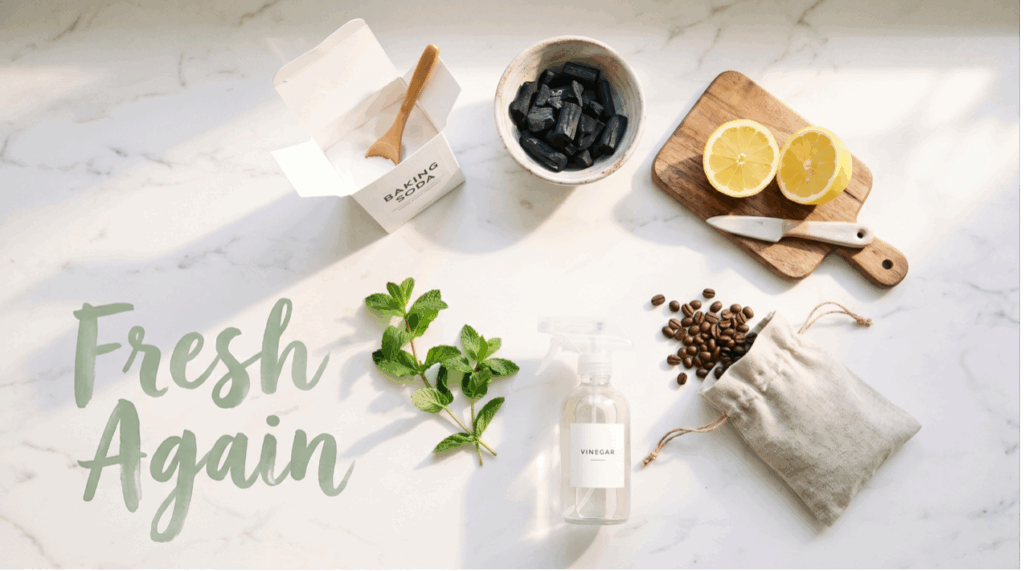
Most fridge odours come from spoiled food, organic residue, moisture, mould, or spills hidden inside the cabinet. The most reliable fix is to find and remove the source. Odour absorbers like baking soda help, but they are a finishing step, not a substitute.
This guide covers what causes the smell, seven natural absorbers ranked by how they actually work, a four-step deep clean for stubborn cases, and the prevention habits that keep the problem from coming back.
What is actually causing the smell
Bacteria break down organic material and release volatile organic compounds (VOCs) as a byproduct. Different VOCs produce different odours. Sour and vinegary smells usually come from spoiled dairy. Sulphur or rotten egg notes come from spoiling proteins. Ammonia signals advanced decomposition.
The source is almost always one of these:
- 1An expired item still in the fridge (most common)
- 2A spilled liquid that ran into a crevice or seal
- 3Standing water in the drain hole at the back of the fresh-food compartment
- 4Mould growing in the door gasket
- 5Dust on the rear condenser coils, which can develop a burnt smell when the coils overheat
The order of likelihood matters. If the fridge smells, check inside first, then check the drain hole and gasket, then the coils.
7 natural odour absorbers, ranked by mechanism
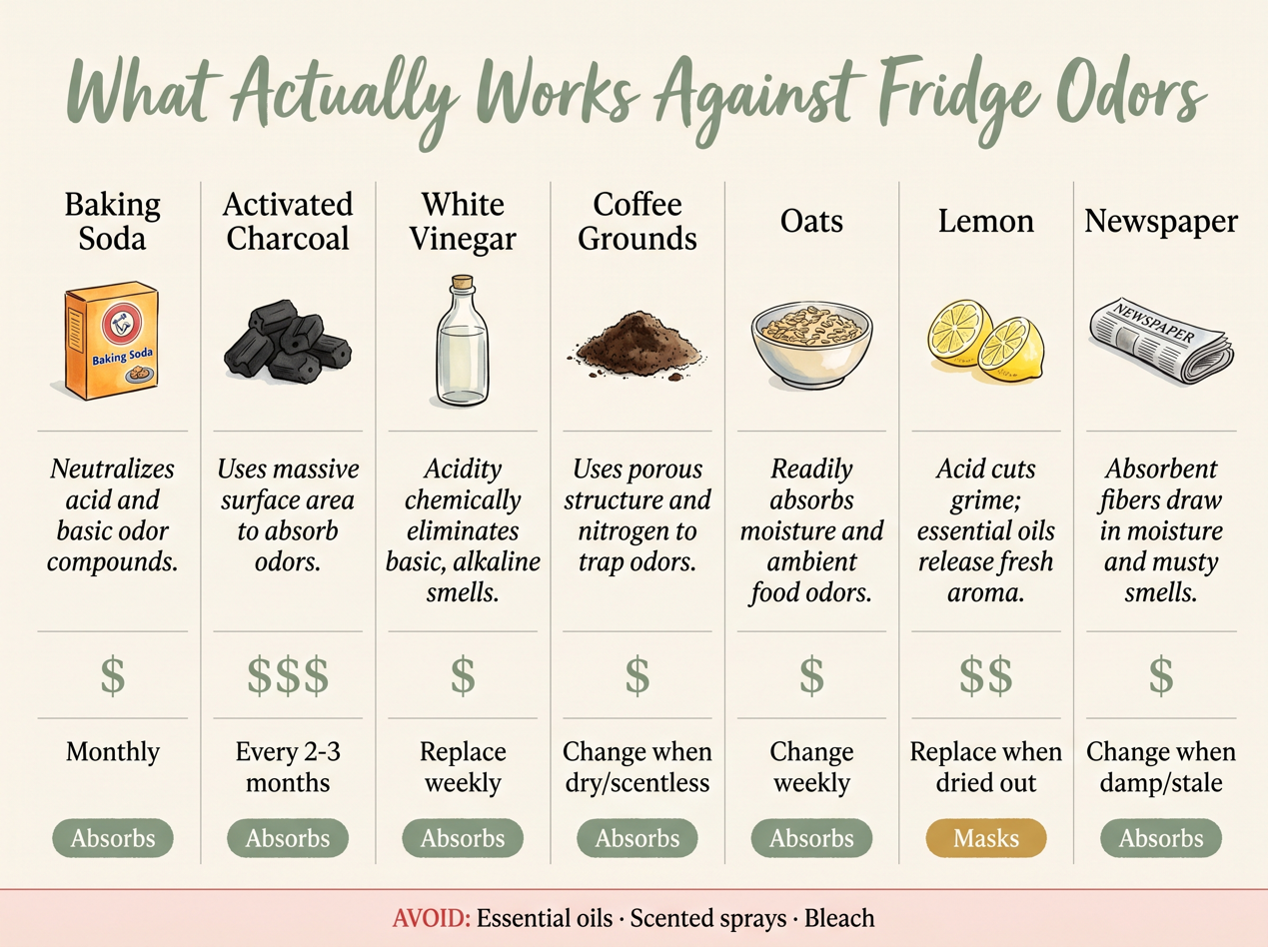
There are dozens of “fridge deodorizer” lists online. Most rank by tradition rather than chemistry. The seven options below are ranked by how the material actually works, with the cost and replacement frequency a household needs to know.
1Baking soda (sodium bicarbonate)
The classic for a reason. Baking soda neutralizes both acidic and basic VOCs through a simple acid-base reaction, converting them to odourless compounds rather than just absorbing them. Open box on a shelf, replace every 30 days. Cost is around $1 per box.
2Activated charcoal
Activated charcoal has a much higher surface area per gram than baking soda, so it adsorbs more VOCs by physical attraction. It does not chemically neutralize the way baking soda does, but it captures a wider range of compounds.
It is reusable. Sun-dry the charcoal for 4 hours every 2 to 3 months and it returns close to original capacity. Cost is around $5 to $10 for a 3 to 6 month supply.
3White vinegar (interior wipe-down only)
Diluted 1:1 with water, white vinegar dissolves food residue and reduces surface bacteria. It is a cleaning agent, not an absorber. Do not leave an open bowl of vinegar in the fridge. Eggs, butter, and dairy will pick up the scent.
4Used coffee grounds (air-dried)
Coffee grounds have a porous structure that adsorbs odours at a similar mechanism to charcoal, but with much lower capacity. They also contribute their own coffee scent. This is a partial cover-up, not a true neutralizer. Useful as a stopgap.
5Uncooked oats
Underrated. The fibre structure adsorbs odours at modest capacity. About half as effective as baking soda by weight. Place in a shallow open bowl. Replace every 30 days.
6Lemon slices
Lemon adds a citrus scent that masks food odours temporarily. It does not absorb anything. Useful for showing the fridge before guests arrive, not for actually solving a smell problem. Replace every 3 to 4 days as the lemon dries out.
7Crumpled newspaper
An emergency stopgap when storing an empty fridge for moving or vacation. The paper absorbs both moisture and faint odours, which is enough for an empty unit. Not effective for an active smell problem.
Two things to avoid
- Essential oils and scented sprays: these mask smells rather than remove them, and the oils can transfer onto food packaging. Avoid.
- Bleach: corrosive to gaskets and plastic liners. Use white vinegar instead.
The 4-step deep clean for stubborn odours
If the smell persists after 48 hours of baking soda, the source is still in the fridge. Time to deep clean.
1Empty and unplug
Move all food into a cooler with ice packs. Unplug the fridge to defrost any frost in the freezer compartment. Plan for 60 to 90 minutes of work.
2Remove and wash all interior parts
Pull out drawers, shelves, and door bins. Wash in the sink with warm water and either dish soap or a paste of baking soda and water. Rinse thoroughly. Air dry on a clean towel.
Glass shelves can crack if they go from cold to hot water. Let them warm to room temperature for 15 minutes before washing.
3Wipe interior walls
Mix 1 part white vinegar to 1 part warm water in a spray bottle. Spray every interior surface, including the ceiling and the back wall, and wipe with a microfiber cloth. Pay attention to the seams where the liner meets shelves.
4Clean the three hidden sources
This is the step most cleanings miss, and it is usually where the persistent smell lives.
A small hole at the back of the fresh-food compartment, near the bottom. Standing water and food particles accumulate here. Clean with a cotton swab dipped in vinegar, then flush with hot water.
The rubber seal around the door. Mould grows in the folds. Scrub with a toothbrush and the vinegar solution, then dry completely.
Pull the fridge out and vacuum the coils at the back or bottom. Burnt or musty smells often come from dust accumulation here.
Finishing step
After the deep clean, place open baking soda on a shelf and run the fridge empty for 4 hours before restocking. The empty cycle pulls residual moisture out.
5 habits that prevent the problem
Most fridge smells trace back to small daily habits. Five that make the biggest difference:
- 1Seal leftovers in airtight containers before refrigerating.
Open containers release odours over a 2 to 3 day cycle. The U.S. Department of Agriculture’s general rule is leftovers in shallow airtight containers within 2 hours of cooking [1]. - 2Check crisper drawers weekly.
Forgotten produce is the single most common smell source. A 30-second weekly check prevents 80 percent of cases. - 3Store raw meat in sealed containers, not on open trays.
Drips and meat juices that pool under the package are a common odour source even before the meat reaches its expiration date. - 4Wipe the interior fully once a month.
A 5-minute weekly wipe of shelves and a 15-minute monthly clean of the door bins and drawer tops prevents buildup. - 5Empty the fridge before long absences.
If the fridge will be empty for more than a week (vacation, moving), unplug it and prop the door open with a rolled towel. A sealed empty fridge develops mould within days.
Refrigerator features that actively reduce odours
Modern refrigerators can help manage odours in different ways, but the feature logic matters.
Multi-Airflow systems are mainly designed to distribute cold air more evenly throughout the compartment. This helps reduce temperature fluctuations after door openings and supports better freshness, especially for produce and daily groceries.
For stronger odour separation, look for a dual-cooling system or models with independent compartments and separate airflow outlets. By cooling different zones more independently, these systems help reduce air mixing between compartments, making it easier to separate strong-smelling foods such as fish, meat and leftovers.
Even with these features, sealed containers remain the most effective everyday habit for preventing odour transfer.
Selected Homa Multi-Door models use separate compartments and airflow design to help reduce odour transfer.
When the smell will not go away
If you have done the deep clean and the smell returns within a week, three possibilities remain:
1
The odour has penetrated the plastic interior liner.
Plastic is porous, and persistent strong odours (rotten meat, spoiled fish) can soak in. Activated charcoal continuously running for 30 to 60 days sometimes works. Sometimes it does not.
2
Mould is inside the insulation.
This is uncommon but means the plastic liner has cracked and moisture has reached the foam insulation underneath. Once mould is in the insulation, the unit cannot be repaired economically.
3
The smell is chemical, not food.
A sweet or chemical smell can indicate a refrigerant leak. R600a, the refrigerant in most modern fridges, is essentially odourless on its own, but the lubricating oil that circulates with it has a faint chemical smell. Stop using the unit and call service.
FAQs
How long does it take for baking soda to absorb smells?
48 to 72 hours for general fridge odours after the source has been removed. If the smell persists past 72 hours, the source is still inside.
Can I put an open container of vinegar in the fridge overnight?
You can, but other foods will pick up the vinegar scent. Better to use vinegar for wipe-downs only.
Why does my fridge smell even after I cleaned it?
The most likely explanation is that the deep clean missed the drain hole, gasket, or condenser coils. Run through Step 4 again.
Is food safe to eat from a smelly fridge?
The fridge itself does not contaminate sealed food. But a strong odour usually means something inside has spoiled, and unsealed items (uncovered leftovers, fresh produce) can absorb the smell and the bacteria producing it. When in doubt, follow USDA guidance and discard [1].
How often should I replace the odour absorber in my fridge?
Baking soda every 30 days. Activated charcoal every 2 to 3 months with sun-drying in between. Lemon slices every 3 to 4 days.
References
[1] U.S. Department of Agriculture, Food Safety and Inspection Service. “Refrigeration and Food Safety.” FSIS, https://www.fsis.usda.gov/food-safety/safe-food-handling-and-preparation/food-safety-basics/refrigeration. Accessed 9 May 2026.