












The short answer: plan for 4 to 6 cubic feet of fridge capacity per person in your household, then check that the model fits your kitchen with proper ventilation clearance. A typical family of four needs around 20 to 22 cubic feet [1][2].
The long answer is more useful, because the wrong-size refrigerator is one of the most expensive mistakes in a kitchen renovation. Buy too small and grocery storage becomes a daily problem. Buy too big and the unit either does not fit through the doorway or wastes energy you keep paying for.
This guide walks through the formula, a household-size lookup, type comparisons, the measurement checklist, and the lifestyle factors that should adjust your number.
The capacity formula every retailer uses
Industry consensus across appliance manufacturers and retailers is 4 to 6 cubic feet of fridge capacity per person [2][3]. Within that range:
If you shop frequently and buy fresh
Most households (default)
Bulk shoppers, entertainers, home cooks
ENERGY STAR guidance adds an upper bound: the most energy-efficient refrigerator models are typically 16 to 20 cubic feet [4]. Going significantly larger than your household actually needs costs both purchase price and ongoing energy.
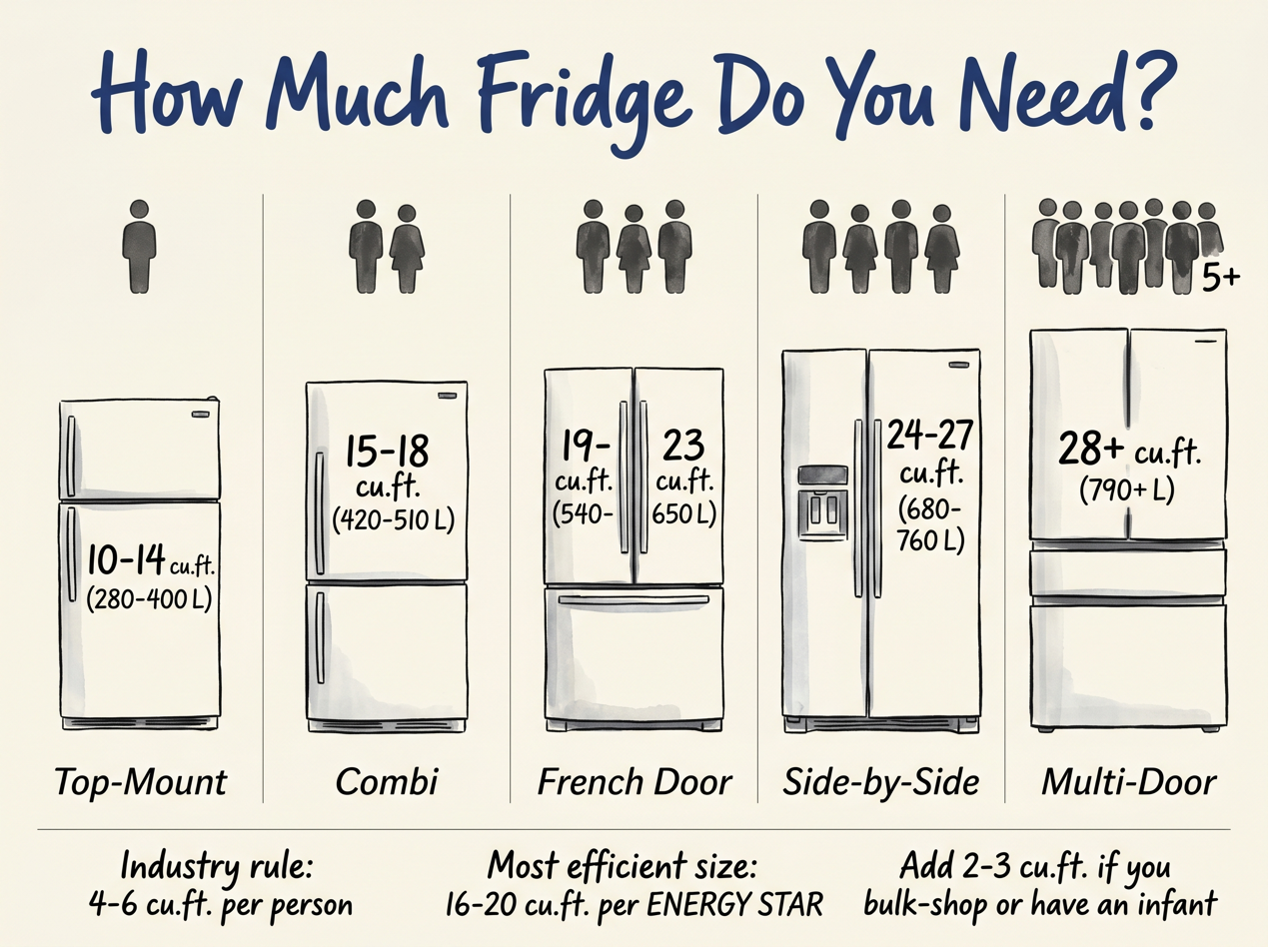
Refrigerator size by family size
This chart synthesizes the consensus across Whirlpool, Angi, and major appliance retailers [1][2][3]. The capacity column is total internal volume (fridge plus freezer combined).
A few caveats:
- These are total capacities. The fridge-to-freezer ratio varies by type (a Side-by-Side has a much larger freezer than a Top-Mount of the same total volume).
- If you keep a second freezer in the garage, you can drop capacity by 3 to 5 cu.ft.
- If you have an infant or toddler at home, add 2 to 3 cu.ft. for breast milk storage, baby food jars, and the inevitable larger leftovers from “kid food” cooking.
Type comparison at common capacities
Not every refrigerator type uses interior space equally. At a given external footprint:
Top-Mount
Often uses space efficiently because of its simple two-compartment layout. It is also the most affordable type. ENERGY STAR notes top-freezer designs tend to use the least energy of any layout [4].
Bottom-Freezer / Combi
Puts the chilled section at waist height, which makes daily use easier because most of what you grab is fresh, not frozen. Slightly less space-efficient than Top-Mount because of the freezer drawer mechanism.
French Door
Wide shelves that fit pizzas, large platters, and party trays. Capacity range is typically 19 to 31 cubic feet [1]. Slightly less space-efficient than Combi, because the dual-door design adds gasket bulk.
Side-by-Side
Often provides a relatively large vertical freezer section, useful for households that cook in batches. Each side is narrow, so wide items (sheet trays, tall bottles) often will not fit.
Multi-Door (4-door)
The most flexible for zoning, with independent temperature control across compartments. Individual doors are narrower than French Door, so each holds less.
Standard-depth, counter-depth, and built-in: how to choose
These three terms describe how the fridge sits relative to your countertops.
Protrudes 7 to 15 cm (3 to 6 inches) past the cabinets. Gives you 20 percent more capacity than a counter-depth unit at the same width and costs less. The trade-off is visual bulk in the kitchen.
Sits roughly flush with the cabinet face, typically 24 to 27 inches (61 to 69 cm) deep [5]. The flush look costs 3 to 5 cubic feet of capacity at the same width. Costs more per cubic foot than standard-depth.
Designed to integrate with cabinetry, usually fully flush and accepting custom door panels for a seamless look. Taller and shallower, often spanning the full cabinet height. Most expensive of the three.
If a “built-in look” matters more than maximum capacity and you want to avoid the price jump to true built-in, the Slot-In category sits between counter-depth and built-in, designed to fit flush with cabinetry while keeping standard ventilation clearance.
Kitchen space measurement checklist
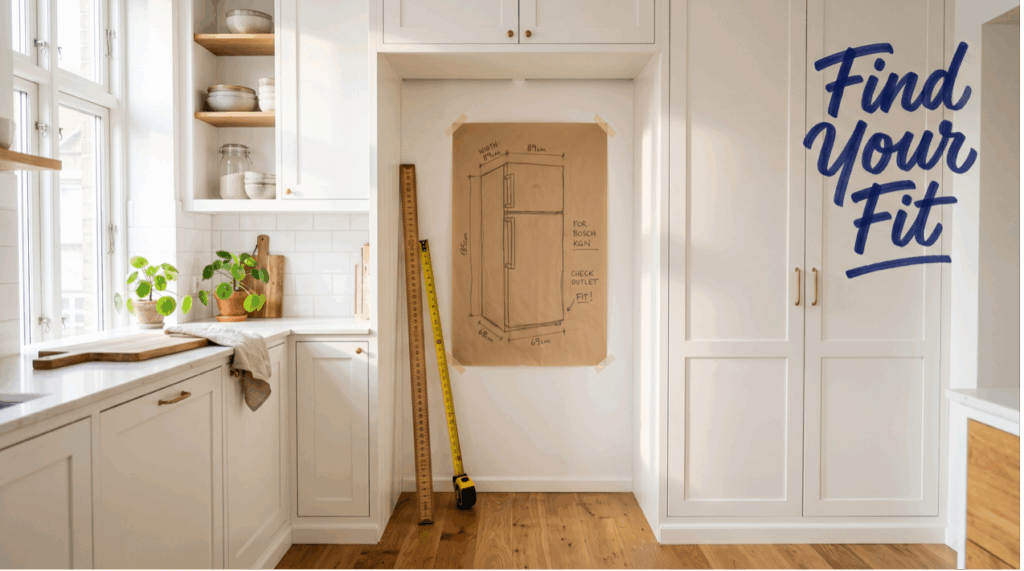
Measure six dimensions, in this order. The most common reason a refrigerator gets returned is one of these was missed.
- 1Width of the alcove at its narrowest point.
Often the door frame, not the cabinet opening. Measure top, middle, and bottom; cabinets are not always plumb. - 2Depth from the back wall to the front of adjacent cabinets.
This sets whether standard-depth or counter-depth is your option. - 3Height from the floor to the underside of the upper cabinet or ceiling.
Allow about 1 inch (25 mm) of clearance above the unit for ventilation. - 4Delivery path width.
Measure your front door, hallway, any turns, and elevator if applicable. A 36-inch refrigerator does not always fit through a 32-inch door. - 5Door swing clearance.
Most refrigerators need at least 90 degrees of door swing to remove crisper drawers. Measure from the hinge side to any obstruction. - 6Ventilation clearance.
Manufacturer spec sheets vary, but a typical requirement is roughly 1 inch (25 mm) on the sides and top, and 2 inches (50 mm) at the back. Check the spec sheet for your specific model. Without ventilation, the compressor runs hotter and harder, which raises both energy use and wear.
Lifestyle factors that change the math
The 4 to 6 cubic feet per person rule assumes a typical household. Five factors that shift it:
Weekly bulk shoppers need 1 to 2 cu.ft. more per person than daily fresh shoppers. The difference between buying 7 days of milk at once versus one carton at a time is real.
Hosting a dinner party means 2 cu.ft. of trays and platters that have to fit somewhere. Lean toward French Door, which has the widest interior shelves.
Plant-based and high-produce diets need larger crisper drawers. Keto and high-meat diets need a larger freezer compartment for batch buys. Match the layout to the contents.
Households where all three meals are eaten at home use roughly 15 percent more storage than households where lunch is eaten elsewhere.
Add 2 to 3 cu.ft. for milk storage, baby food jars, and prepared meals.
5 sizing mistakes to avoid
- 1Comparing only gross volumes.
Two units with the same exterior dimensions can differ by 20 percent in usable interior space — insulation thickness, door shelf depth, and compressor placement all eat into the number. Always check the net usable capacity on the spec sheet, or visit a showroom and measure shelf space directly. - 2Forgetting door swing.
A French Door fridge installed in a corner often cannot open the right-side door fully if a wall sits within 12 inches. Crisper drawers cannot be removed for cleaning. - 3Skipping ventilation clearance.
A unit pushed flat against the back wall runs hotter, uses more energy, and shortens compressor life. The ventilation gap is not optional. - 4Buying big without checking the circuit.
Many large French Door and Side-by-Side units in the US specify a dedicated 15-amp circuit. Sharing a circuit with a microwave often trips the breaker. - 5Ignoring the delivery path.
A standard 36-inch wide refrigerator will not pass through a 32-inch door without removing the door from the unit. Some models have detachable doors; others do not. Check before purchase.
A worked example
Family of four, two adults and two school-age children, weekly grocery run on Sundays, occasional weekend entertaining, kitchen alcove 36 inches (91 cm) wide:
20 cu.ft.
+ 1 cu.ft.
+ 1 cu.ft.
22 cu.ft.
With 91 cm width available, French Door at 22 cu.ft. fits the math and the kitchen. Counter-depth would drop usable capacity to roughly 18 cu.ft., which is borderline for this family.
FAQs
What is a good size refrigerator for a family of 4?
Around 20 to 22 cubic feet. Industry guidance from Whirlpool and Angi converges on this range.
Is 25 cubic feet too big for 2 people?
Probably yes, both for cost and energy. ENERGY STAR notes the most efficient refrigerators are typically 16 to 20 cu.ft. [4]. A 2-person household is usually comfortable in the 11 to 14 cu.ft. range.
How do I measure the space for a new refrigerator?
Width at the narrowest point, depth, height, delivery path width, door swing clearance, and ventilation clearance. The full checklist is in the section above.
Do I need counter-depth if I have a small kitchen?
Counter-depth is a visual choice, not a fit requirement. A standard-depth fridge that protrudes 5 inches into the room is often acceptable in small kitchens if walkway clearance is preserved. Counter-depth costs more and gives less capacity.
Can a refrigerator be too big for energy efficiency?
Yes. Larger refrigerators use more energy regardless of efficiency rating. ENERGY STAR-certified refrigerators are about 9 percent more efficient than the federal minimum standard at the same size [4], but a 28 cu.ft. ENERGY STAR unit still uses more total energy than a 20 cu.ft. ENERGY STAR unit.
For a household trying to balance capacity and efficiency, the rule is: buy the smallest refrigerator that comfortably handles a typical week of groceries plus a 20 percent buffer.
To find a Homa refrigerator at your target capacity and width, browse the full product range with size filters.
References
[1] Whirlpool Corporation. “Refrigerator Sizes & Dimensions: A Guide for Measuring Your Fridge.” Whirlpool, https://www.whirlpool.com/blog/kitchen/guide-to-refrigerator-sizes-dimensions.html. Accessed 9 May 2026.
[2] Angi. “Refrigerator Sizes & Dimensions: A Guide for Measuring Your Fridge.” Angi, 5 Apr. 2026, https://www.angi.com/articles/refrigerator-size.htm. Accessed 9 May 2026.
[3] Spencer’s TV & Appliance. “What Refrigerator Size Do I Need?” Spencer’s, 18 May 2023, https://www.spencerstv.com/blog/refrigerator-sizes-buying-guide. Accessed 9 May 2026.
[4] U.S. Environmental Protection Agency. “Refrigerators.” ENERGY STAR, https://www.energystar.gov/products/refrigerators. Accessed 9 May 2026.
[5] East Coast Appliance. “Fridge Sizes, Dimensions, & Capacity Explained.” East Coast Appliance, 14 Nov. 2025, https://www.eastcoastappliance.com/blog/standard-fridge-size. Accessed 9 May 2026.