












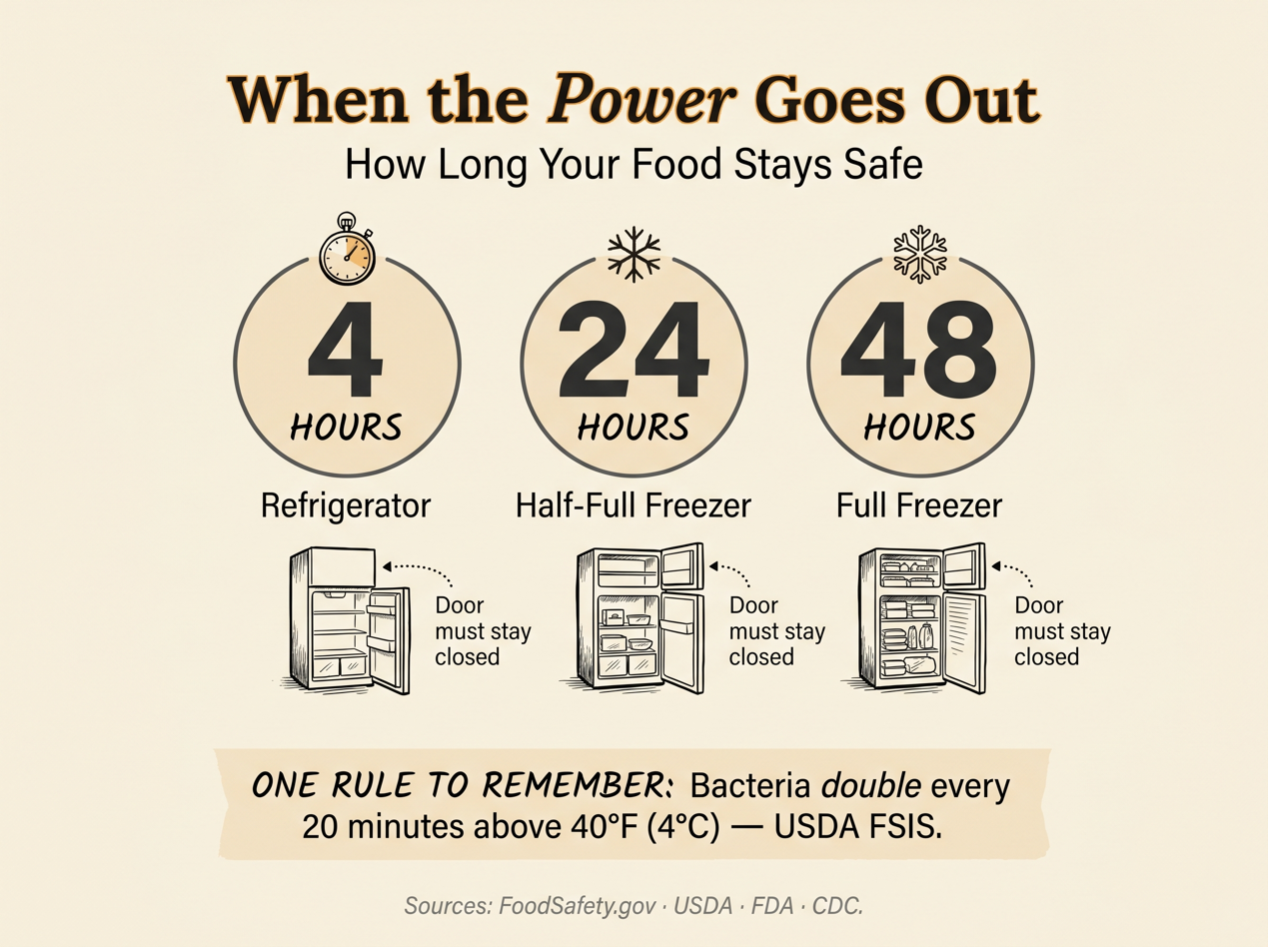
The rule to remember: 4 hours, 24 hours, 48 hours.
After a power outage, your refrigerator keeps food safe for up to 4 hours if the door stays closed. A half-full freezer holds for 24 hours. A full freezer holds for 48 hours [1][2][3]. Past those windows, perishable food has to be discarded.
These are official USDA, FDA, and CDC safety guidelines. Actual holding time can vary depending on room temperature, door openings, insulation and how full the appliance is. This guide covers how to apply the rule, what to discard versus what to keep, what to do before and during an outage, and how to recover when power returns.
The 4 / 24 / 48 rule
Sources: FoodSafety.gov [1], USDA FSIS [2], FDA [3]. Please note that this information may vary depending on the refrigerator’s performance specifications.
The “door stays closed” condition is not a footnote. Each opening lets warm air in and shortens the safe window. If the outage lasts longer than 4 hours and you have opened the fridge multiple times, the safe window is shorter than 4 hours.
Why those exact numbers
Bacteria grow fastest between 4°C and 60°C (40°F and 140°F), a range the USDA calls the “Danger Zone.” In this range, common foodborne pathogens including Salmonella, E. coli, and Listeria can double in number in as little as 20 minutes [4].
A modern refrigerator’s insulation keeps interior temperatures at or below 4°C for roughly 4 hours after power loss. A full freezer lasts twice as long as a half-full freezer because the frozen food itself acts as thermal mass, helping keep neighbouring items cold as the surrounding air warms.
This is why the FDA explicitly recommends grouping food together in the freezer if you know an outage is coming [3]. Tighter packing means more thermal mass and a slower temperature rise.
What to discard vs. what to keep
The USDA FSIS provides a clear two-list framework. After 4 hours above 4°C:
✕
Discard
- Raw meat, poultry, fish, and shellfish
- Cooked dishes, cooked meat, and leftovers including rice and pasta
- Dairy, including milk, cream, soft cheeses, and yogurt
- Opened mayonnaise and salad dressings
- Cut watermelon, cantaloupe, and other cut low-acid fruit
- Tofu and similar protein products
- Eggs (in or out of shell), egg substitutes, and egg-based custards
✓
Keep
- Hard cheeses, butter, and margarine
- Whole uncut fruits and vegetables
- Opened jam and peanut butter
- Condiments including ketchup, mustard, soy sauce, vinegar-based pickles
- Unopened bottled liquids
- Bread and most baked goods
The USDA has a separate rule for opened mayonnaise, tartar sauce, and horseradish: discard after 8 hours above 50°F [2]. High-acid foods (mustard, ketchup, jams, jellies, vinegar dressings) generally do not require refrigeration for safety even when normally stored cold.
Freezer items: the ice crystal test
Freezer contents work differently from refrigerator contents. The CDC and FDA agree on the test:
Refreeze
Cook now
Discard
Refreezing partially thawed food is safe, but quality may suffer. A refrozen pound of ground beef cooks fine but may release more water and have a slightly mushier texture.
Before an outage: 5 preparations
If you live in a region with hurricane or winter storm risk, do these once before the season starts.
- 1Set your refrigerator to 1 to 2°C (34 to 36°F) instead of the default 4°C.
Before a forecast outage, setting the refrigerator slightly colder within the safe range may help slow temperature rise. - 2Freeze water bottles or gel packs.
Stack them in any empty space in the freezer. They serve two purposes: thermal mass to extend cold retention, and emergency drinking water if your municipal supply is also affected. - 3Keep an appliance thermometer in both the fridge and the freezer.
This is the single most useful item for judging safety after power returns. The fridge thermometer should read 40°F or below; the freezer 0°F or below [3]. - 4Know where to buy dry ice or block ice.
USDA guidance: 50 pounds of dry ice will hold an 18 cubic foot full freezer for 2 days [2]. Most home improvement stores and some grocery stores stock it, but supply runs out fast in the hours before a storm. - 5Keep a cooler in the garage or closet.
When the outage exceeds 4 hours, transferring perishables to a cooler with ice extends their safe window indefinitely as long as the cooler stays at 40°F or below.
During the outage: do this, not that
✓
Do
- Keep the doors fully closed unless you are removing items to a cooler
- Move chilled items to the freezer if the outage will be long; the freezer holds longer
- Keep the doors closed and use a cooler with ice for perishables if the outage is extended
✕
Don’t
- Open the door to “check” the temperature; this is the fastest way to lose your safe window
- Place hot food in a powered-off refrigerator; it raises interior temperature quickly
- Judge food safety by smell or appearance alone; many bacterial toxins are invisible and odourless [4]
Physics note
Cold air sinks. This means chest freezers tend to retain cold longer than uprights, because cold air does not rush out as easily when the lid is briefly lifted. If you are replacing a freezer specifically for outage resilience, a chest freezer is the technically stronger choice. See Homa’s chest freezer range.
After power returns: recovery checklist
When the power comes back, work through these five steps.
- 1Record the total outage duration.
This is the single most important number for the decisions that follow. - 2Check the appliance thermometer in each compartment.
The fridge should read 40°F or below; the freezer 0°F or below. If the fridge reading is above 40°F, the contents have been in the Danger Zone for some portion of the outage. - 3Work through the must-discard and keep lists.
Item by item. Use the USDA chart at FoodSafety.gov as a tiebreaker when you are unsure [1]. - 4Deep clean the interior.
Liquid often leaks from packaging during an extended outage as items thaw or as condensation builds. - 5Recheck temperatures 24 hours after restocking.
A unit that ran in a hot environment for 2 days may need extra time to return to spec, or it may have suffered damage that requires service.
Generators, ice, and how long an outage lasts
Match your response to the outage duration:
Hot weather caveat
For long outages in hot weather, the calculation changes. At ambient temperatures above 90°F, the safe window shrinks. The USDA’s general 2-hour rule for room-temperature food drops to 1 hour above 90°F [4].
FAQs
How long will food stay frozen in a freezer without power?
48 hours if the freezer is full. 24 hours if it is half-full. The door must stay closed [1].
Is milk safe after a 6-hour power outage?
No. Milk is on the discard list after 4 hours above 40°F per USDA guidance [2].
Can I refreeze thawed meat?
Yes if the meat still contains ice crystals or is at 40°F or below. The USDA confirms refrigerated or partially thawed food can be safely refrozen, though quality may suffer [3].
What should I do if my fridge was off all night?
If the outage exceeded 4 hours, follow the discard list. Mayonnaise, dairy, cooked leftovers, raw meat, and cut produce all go.
Does homeowners’ insurance cover food lost in a power outage?
Many homeowners and renters’ insurance policies cover food spoilage from a power outage, typically with a $500 limit. Check your policy. Document spoiled items with photos before you discard them.
A printable version of the 4 / 24 / 48 chart is in the works. Until then, save this page or screenshot the chart at the top of the article. The most useful place for this information is on your phone before the storm, not after the power is out.
For families in regions with frequent extended outages, Homa’s chest freezer range offers larger capacity and longer cold retention than upright designs.
References
[1] U.S. Department of Health and Human Services. “Food Safety During Power Outage.” FoodSafety.gov, 8 Aug. 2024, https://www.foodsafety.gov/food-safety-charts/food-safety-during-power-outage. Accessed 9 May 2026.
[2] U.S. Department of Agriculture, Food Safety and Inspection Service. “Keep Your Food Safe During Emergencies: Power Outages, Floods & Fires.” FSIS, https://www.fsis.usda.gov/food-safety/safe-food-handling-and-preparation/emergencies/keep-your-food-safe-during-emergencies. Accessed 9 May 2026.
[3] U.S. Food and Drug Administration. “Food and Water Safety During Power Outages and Floods.” FDA, https://www.fda.gov/food/buy-store-serve-safe-food/food-and-water-safety-during-power-outages-and-floods. Accessed 9 May 2026.
[4] U.S. Department of Agriculture, Food Safety and Inspection Service. “‘Danger Zone’ (40°F – 140°F).” FSIS, https://www.fsis.usda.gov/food-safety/safe-food-handling-and-preparation/food-safety-basics/danger-zone-40f-140f. Accessed 9 May 2026.