












If your refrigerator is over 10 years old and any major component is failing, replacement usually beats repair. If it is under 7 years old, repair almost always wins. The decision in between depends on the cost of the repair, the energy efficiency of your current unit, and what type of refrigerant it uses.
This guide covers the seven signs that say it is time to replace, the maintenance habits that buy you 3 to 5 more years if it is not yet, and what to look for in a 2026 buying checklist.
How long refrigerators actually last
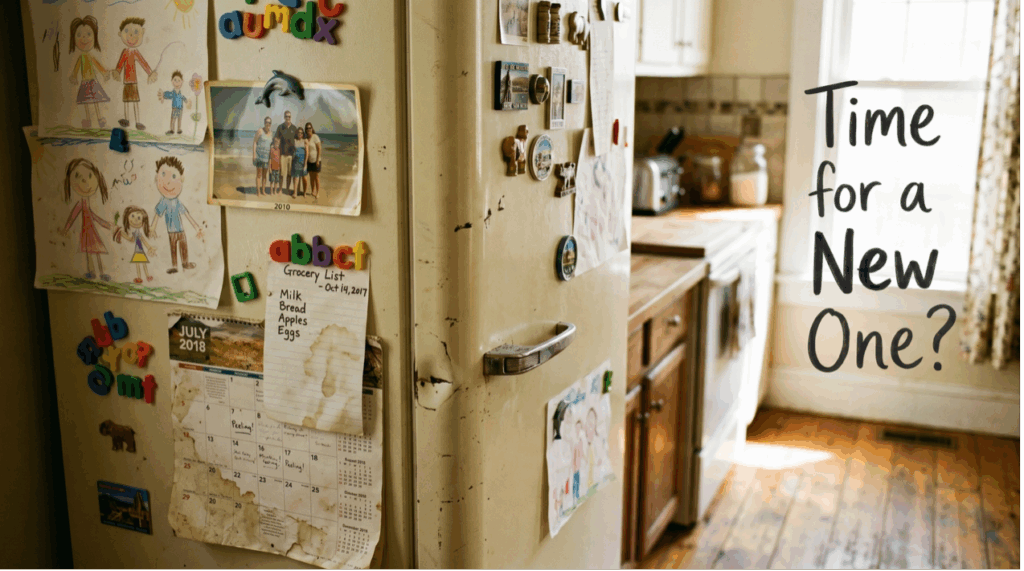
Manufacturers and Consumer Reports converge on a roughly 10-year average expected lifespan for modern domestic refrigerators. Consumer Reports’ 2021 survey found that 37 percent of refrigerators purchased between 2011 and 2021 broke or stopped working as well as they should have within that decade [1].
By type, the typical service life ranges:
Top-Mount units last longest because the design is simplest. Fewer electronic components and a single cooling system means fewer parts that can fail. French Door units have the most electronics and the most door gaskets, which is why they are at the lower end of the range.
These are typical service lives, not deadlines. A well-maintained Top-Mount can run 17 to 20 years. A poorly maintained French Door can fail at 7.
7 signs it’s time to replace
1Excessive frost buildup
Frost should not accumulate in a No-Frost refrigerator. If it does, it usually points to an airflow, door-seal or defrost-system issue.
On older non-No-Frost models, manual defrosting every 2 to 3 months is normal. If you are defrosting every month or finding new frost a week after a manual defrost, the seal or the cooling system is no longer holding spec.
2Food spoiling faster than it should
Three causes worth checking:
- A worn door gasket. Quick test: close the door on a piece of paper. If you can pull the paper out without resistance, the seal has failed. A replacement gasket is typically $30 to $60 and a 30-minute job.
- Temperature drift. The thermostat is reading wrong, so the fridge runs at 7°C when it should run at 4°C. An appliance thermometer confirms this in 30 minutes.
- A refrigerant leak. The system is undercharged and cannot maintain temperature. This requires service and on a 10+ year old unit usually means replacement.
If a new gasket and thermostat check both come back clean and food is still spoiling, the system is failing.
3The compressor runs constantly
On older single-speed models, the compressor should cycle on and off. Inverter compressors may run for longer periods at low speed. If a compressor runs continuously without cooling well, three causes are common:
- Dust on the condenser coils, forcing longer run cycles to remove heat
- Low refrigerant from a slow leak
- A worn compressor that no longer cools efficiently
Vacuum the coils first. If continuous running persists after cleaning, check door seals, airflow, fan operation and temperature settings before assuming a sealed-system fault.
4Your electric bill has risen with no obvious cause
A 10-year-old refrigerator that was Class A when new is now performing well below current Class A standards. Modern ENERGY STAR-certified refrigerators are about 9 percent more efficient than the federal minimum standard, and they save more than $220 over a 12-year lifespan compared to a non-certified unit [2][3].
If your electric bill jumped $20 to $30 a month with no other change in the house, the refrigerator is a leading suspect.
5New noises, especially grinding or continuous clicking
Persistent grinding indicates either compressor wear or a damaged condenser fan blade. Continuous clicking usually means the start relay is failing.
A grinding compressor will fail within weeks to months. The replacement cost typically lands in the $400 to $800 range depending on model and region. On a refrigerator over 10 years old, that money is better applied to a new unit.
6Repair quote exceeds 50 percent of a new unit’s price
The often-quoted “50 percent rule” is the most useful single threshold. If a major repair costs more than half the price of a comparable new unit, replacement wins on total cost of ownership.
Common major repair ranges:
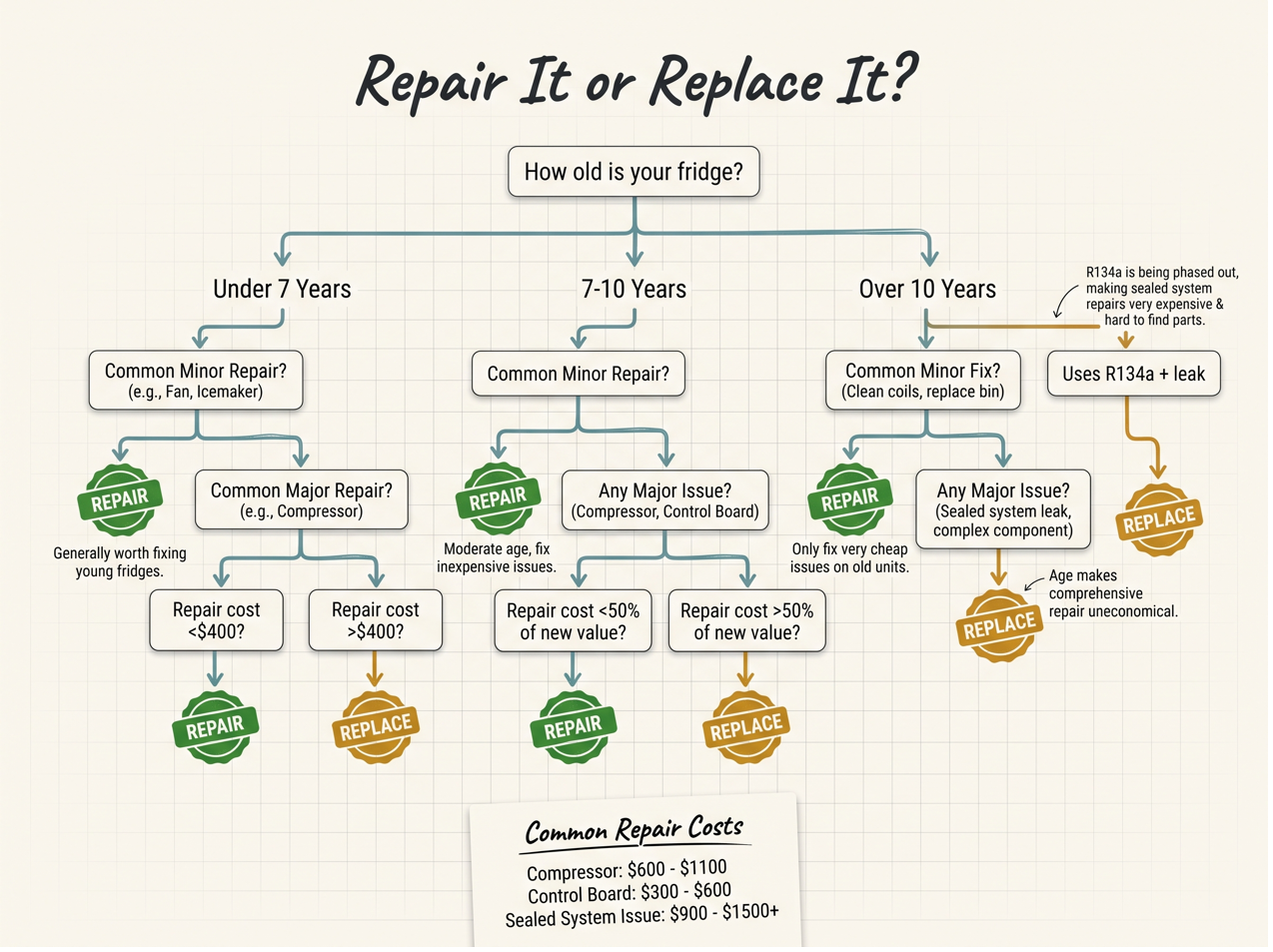
Prices vary by region and model. Get the quote before deciding. A 5-year-old refrigerator with a $400 control board failure should be repaired. A 12-year-old refrigerator with the same failure should usually be replaced.
7The unit uses an obsolete refrigerant
Older domestic refrigerators in the US used R134a. Many older commercial and some larger residential units used R404A. Both are being phased down: R134a under the EU F-Gas Regulation since 2015 and the US AIM Act since 2021, and R404A more aggressively in both regions.
For domestic refrigerators specifically, most EU manufacturers shifted to R600a (isobutane) over a decade ago. R600a has a much lower GWP than R134a, typically over 99% lower.
The practical implication: if your unit uses R134a or R404A and it leaks, refilling becomes increasingly expensive as supply restrictions tighten. On a unit over 10 years old with a refrigerant leak, replacement makes more sense than chasing the leak.
The repair-vs-replace decision matrix
Use the following decision flow when a major repair is on the table:
This matrix is conservative. A 9-year-old refrigerator with a $300 compressor diagnosis is technically a “replace” by this matrix, but if the unit otherwise works well and you are not concerned about energy efficiency gains, the repair can still make sense.
5 maintenance habits that extend life by 3 to 5 years
If your fridge is not yet at the replace point, these habits keep it running longer.
- 1Vacuum the back condenser coils every 6 months.
This single habit can improve efficiency by about 15 percent and reduces compressor load. Pull the unit out, find the coils at the back or bottom, and vacuum the dust off. 15 minutes, no tools. - 2Check the door gasket every year, replace it if needed.
A failed seal forces the compressor to run more, which raises both energy use and wear. The paper test takes 5 seconds, the replacement gasket is $30 to $60. - 3Do not overpack.
A jammed-full refrigerator blocks airflow, which forces the compressor to work harder to maintain temperature. Aim for roughly 75 percent full, which is the sweet spot between thermal mass and airflow. - 4Keep the fridge away from heat sources.
Direct sunlight, an oven on the adjacent wall, or a dishwasher exhaust hitting the side all raise the workload. If a redesign is not practical, at minimum maintain the 2 inch (50 mm) rear ventilation gap. - 5Maintain ventilation clearance.
1 inch (25 mm) on the sides and top, 2 inches (50 mm) at the back. A unit shoved tight against the wall runs hotter, uses more energy, and dies sooner.
What to look for in a new refrigerator (2026 checklist)
If the diagnosis is replacement, these are the specifications worth prioritizing.
On the new EU A to G scale, target Class A or B. In the US, target ENERGY STAR Most Efficient. The DOE notes ENERGY STAR-certified refrigerators save more than $220 over a 12-year lifetime versus the federal minimum [3].
Quieter, more efficient, and longer-lasting than single-speed compressors. The compressor is also typically the longest component warranty, often 10 years on inverter models.
R600a (isobutane) is now standard in most domestic refrigerators sold in the EU and is increasingly common in North America. Avoid units that still use R134a.
The USDA notes that produce drawers are most useful when humidity is matched to the contents [4]. High humidity for leafy greens, low humidity for stone fruit and apples.
EU Ecodesign rules now require manufacturers to provide spare parts for at least 7 years for many appliance categories. Manufacturers that publicly commit to longer parts availability (10+ years) are signalling design for durability rather than for replacement.
Sizing is covered in detail in our companion size guide. Quick rule: 4 to 6 cubic feet per person, with a 1-inch ventilation gap on the sides and top.
Responsible disposal: what happens to your old fridge
Refrigerators contain refrigerant and insulation foam blowing agents that cannot legally be released into the atmosphere. Section 608 of the US Clean Air Act requires recovery of refrigerant before any appliance is dismantled or disposed [5].
Two options for responsible disposal:
EPA RAD program
Responsible Appliance Disposal: a voluntary partnership where utilities, retailers, and recyclers commit to capturing refrigerant, foam blowing agent, and durable materials. The program processed over 9 million refrigerated appliances between 2006 and 2025 [5]. Many electric utilities offer rebates ($30 to $75 typical) when an old refrigerator is recycled through a RAD partner.
WEEE scheme
In the EU, retailers are required to take back the old unit free of charge when delivering a new one. This is the easiest option in most EU countries: the old fridge is collected when the new one is dropped off.
Common mistake
Keeping the old refrigerator running in the garage as a “second fridge.” The DOE notes that an old refrigerator uses about 35 percent more energy than a new ENERGY STAR-certified model [3]. Keeping it plugged in negates most of the savings from the new unit.
For information on Homa’s sustainability commitments and end-of-life materials, see the Sustainability page.
FAQs
How long do refrigerators last on average?
Around 10 years of expected service from the unit as a whole, per Consumer Reports’ 2021 member survey [1]. Top-Mount designs typically last longer (14 to 17 years), French Door units shorter (10 to 12 years).
Is it worth repairing a 10-year-old refrigerator?
For a trivial repair (gasket, thermostat, levelling foot), yes. For a major repair (compressor, control board, sealed system), usually no. The 50 percent rule of thumb says replace if the repair exceeds half the price of a new unit.
What is the 50 percent rule for appliance repair?
A common consumer guideline: replace rather than repair if the repair quote exceeds 50 percent of the price of a comparable new unit. The rule is stricter for older appliances and more lenient for newer ones.
Do new refrigerators really use less electricity?
Yes, significantly. ENERGY STAR-certified refrigerators are about 9 percent more efficient than the federal minimum standard. A unit over 15 years old uses roughly $95 per year more electricity than a current ENERGY STAR model [2].
Can I recycle my old fridge for free?
In most EU countries, yes, when the retailer delivers a new one. In the US, many utilities offer rebates of $30 to $75 for recycling through the EPA RAD program [5]. Some retailers offer free pickup with delivery of a new unit.
To compare current Homa refrigerator models by capacity, type, and dimensions, browse the full product range.
References
[1] Consumer Reports. “How to Make Your Refrigerator Last Longer.” Consumer Reports, 26 Jun. 2022, https://www.consumerreports.org/appliances/refrigerators/how-to-make-your-refrigerator-last-longer-a3675077642/. Accessed 9 May 2026.
[2] U.S. Environmental Protection Agency. “Refrigerators.” ENERGY STAR, https://www.energystar.gov/products/refrigerators. Accessed 9 May 2026.
[3] U.S. Department of Energy. “Purchasing and Maintaining Refrigerators and Freezers.” Energy.gov, https://www.energy.gov/energysaver/purchasing-and-maintaining-refrigerators-and-freezers. Accessed 9 May 2026.
[4] U.S. Department of Agriculture, Food Safety and Inspection Service. “Refrigeration and Food Safety.” FSIS, https://www.fsis.usda.gov/food-safety/safe-food-handling-and-preparation/food-safety-basics/refrigeration. Accessed 9 May 2026.
[5] U.S. Environmental Protection Agency. “Appliance Disposal.” EPA, 18 Jul. 2025, https://www.epa.gov/section608/appliance-disposal. Accessed 9 May 2026.