












Every modern refrigerator quietly fights a hidden enemy: frost. Left unchecked, even a thin layer of ice on the evaporator coils can raise your energy bill and shorten the life of your appliance.
The defrost system is the mechanism that prevents this, and understanding how it works helps you choose the right fridge, spot problems early, and keep your food fresher for longer.
What Is a Refrigerator Defrost System?
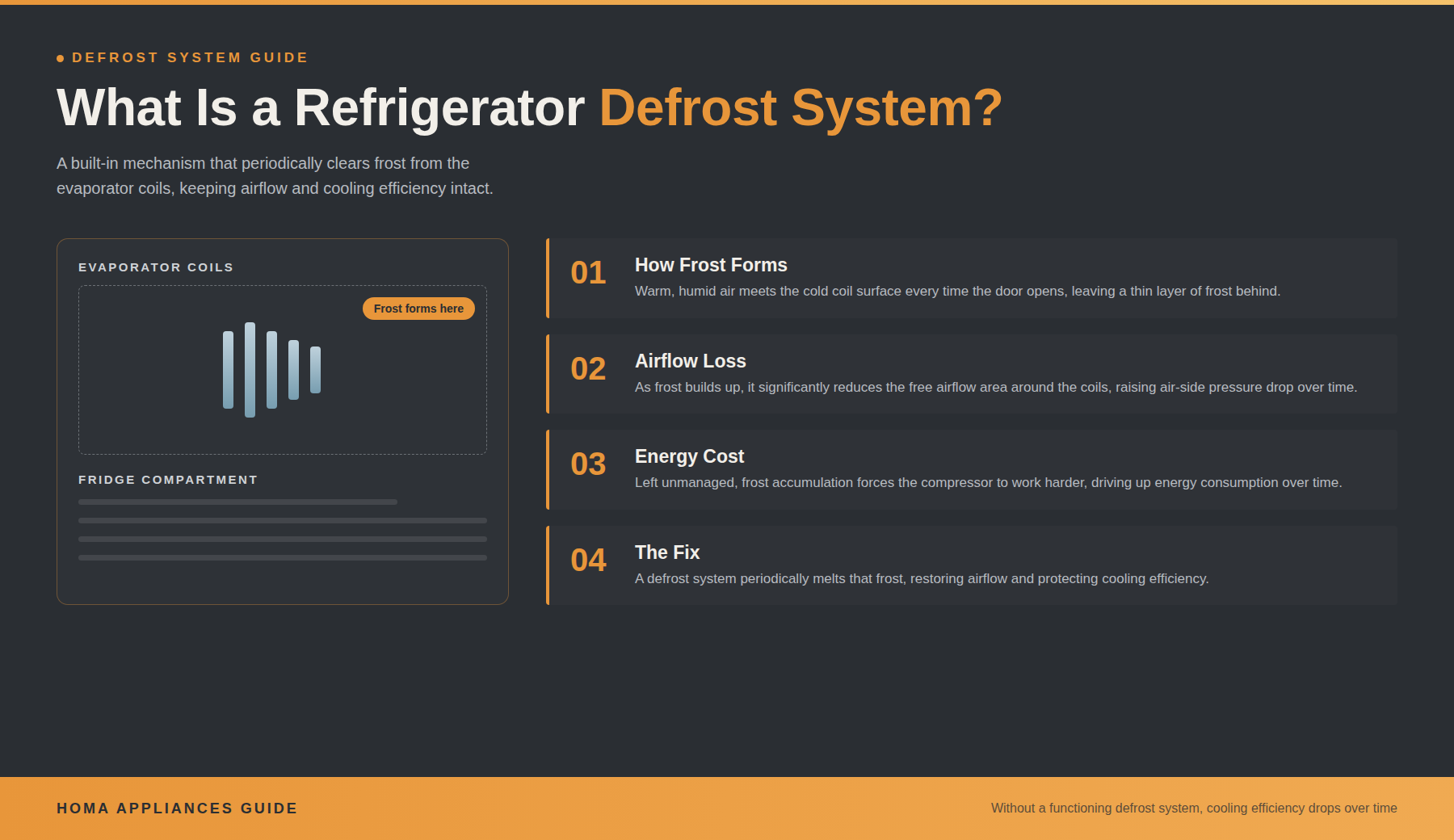
A refrigerator defrost system is a built-in mechanism that periodically removes frost and ice from the evaporator coils, the component responsible for cooling the air inside your fridge.
Frost forms naturally whenever warm, humid air meets the cold surface of the coils, typically every time you open the door. Over time, this frost builds into an insulating layer that blocks airflow and forces the compressor to work harder. Defrost strategy is itself a meaningful driver of efficiency: in tests on domestic refrigerators, switching from fixed-interval to adaptive defrost cut energy use by roughly 5–13%[3]. Research from the University of Illinois’ Air Conditioning and Refrigeration Center has also documented how frost accumulation significantly alters evaporator performance, changing both heat transfer efficiency and airflow resistance over time[1].
In short, without a functioning defrost system, your refrigerator gradually loses its ability to cool efficiently. The consequences include higher electricity costs, uneven temperatures, and potential food spoilage.
Types of Refrigerator Defrost Systems
There are three main types of defrost systems found in household refrigerators today.
Manual Defrost
The simplest approach: you switch the appliance off, empty it, and wait for the ice to melt naturally. This is still common in chest freezers and small budget models. It requires no extra components and avoids the slight temperature fluctuations caused by automatic heating cycles, but it demands regular effort, typically whenever frost reaches about a quarter of an inch (≈ 6 mm) in thickness[6].
Automatic (Timed) Defrost
The standard in most modern household fridges. A timer or control board triggers a defrost cycle. Field measurements of real-world use show average intervals spanning roughly 13–37 hours across tens of thousands of cycles, with adaptive controls spacing cycles further apart when frost is minimal[2]. During each cycle, a heating element warms the coils, melts the frost, and a thermostat cuts the heater once the job is done. The whole process runs invisibly in the background with no effort required from you.
Adaptive (Smart) Defrost
An advanced evolution of automatic defrost. Rather than defrosting on a rigid schedule, adaptive systems use sensors to monitor real-world conditions: how often you open the door, how long the compressor has been running, and the actual temperature of the coils. They only trigger a cycle when frost has genuinely built up. Peer-reviewed experimental studies have found that adaptive defrost can reduce a household refrigerator’s total energy consumption by approximately 5.5–13% compared to fixed-timer systems[3].
Quick Comparison
How Does a Refrigerator Defrost System Work?
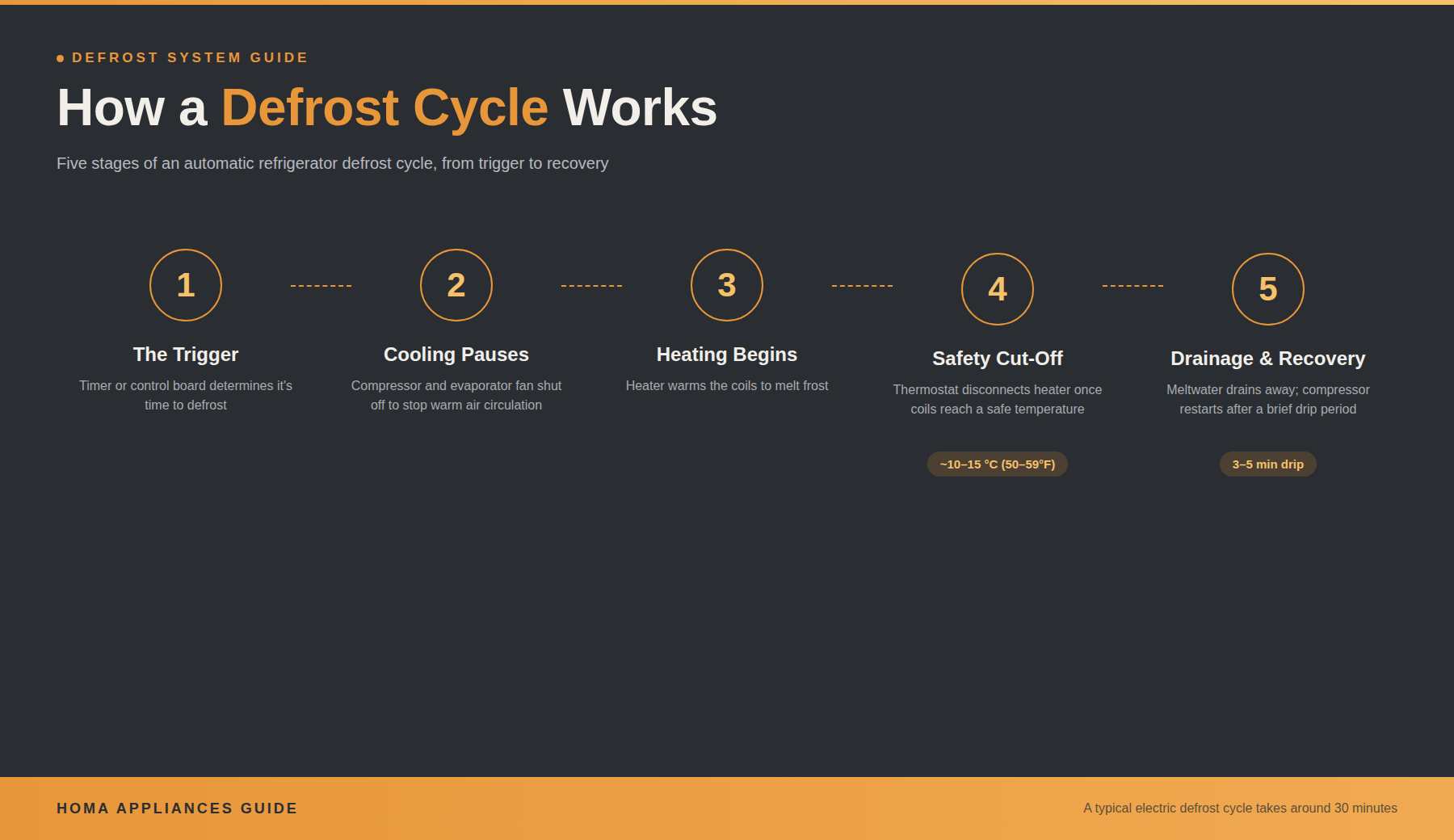
An automatic defrost cycle follows five basic steps:
- 1The trigger.
The timer or control board determines it is time to defrost. - 2Cooling pauses.
The compressor and evaporator fan shut off so that warm air is not circulated into the food compartments. - 3Heating begins.
Residential models commonly use electric defrost heaters. Such defrost heaters and their controls must meet the safety requirements of IEC 60335-2-24[4]. - 4Safety cut-off.
Once the coil temperature rises to typically around 10–15 °C (50–59 °F), the defrost thermostat opens and disconnects the heater, preventing overheating. A typical electric defrost cycle takes about half an hour. - 5Drainage and recovery.
Meltwater flows down a drain tube into a collection pan beneath the fridge, where it evaporates using waste heat from the compressor. After a brief drip period, the compressor restarts and normal cooling resumes.
Adaptive systems follow the same physical process but replace the fixed timer with a sensor-driven control board. If you haven’t opened the door all day, the system may skip or delay the next cycle entirely. If you’ve been loading groceries for half an hour, it may bring the cycle forward. The result is fewer unnecessary heating events and more stable internal temperatures.
Core Components of a Defrost System
Under IEC 60335-2-24[4], the international safety standard for household refrigerating appliances, defrost-related components must meet strict requirements, including defined limits on temperature rise during operation. Electrical controls such as the defrost thermostat must also comply with the endurance requirements set out in IEC 60730-1, the standard for automatic electrical controls referenced within IEC 60335-2-24 (the required number of operating cycles depends on the control’s classification under the standard).
Maintenance Tips and Warning Signs
Daily Habits That Help
- Avoid leaving the door open for extended periods, as humid air accelerates frost build-up.
- Keep internal air vents unblocked so cold air circulates freely.
- Check your door seals regularly; a damaged gasket lets warm air seep in continuously.
- When it’s time to replace an old unit, look for an ENERGY STAR-certified model; these are typically about 9% more energy-efficient than refrigerators that meet only the federal minimum standard[5].
Signs Your Defrost System May Be Failing
Look at the rear wall inside your freezer compartment. A thin, even layer of frost is normal. Thick, uneven ice build-up is not, and it usually points to a defrost system issue.
Frost Free vs. No Frost: What Is the Difference?
These terms are often used interchangeably, but there is a practical distinction.
If you store a lot of fresh produce, a Frost Free model preserves moisture better in the fridge compartment. If you prefer a completely hands-off experience with uniform temperatures, Total No Frost is the better choice. Just remember to keep food sealed or wrapped to prevent dehydration.
How Homa Refrigerators Handle Defrosting
Now that you understand how defrost systems work, here is how Homa puts this technology into practice.
Homa’s Total No Frost range covers Multi-Door, Side-by-Side, and Combi No-Frost configurations. All use multi-airflow circulation across both the fridge and freezer compartments, ensuring even cooling with no manual defrosting required.
Models such as the FF4-54 (Multi-Door) and FF2-69D (Side-by-Side) feature electronic temperature control, LED touch displays, and functions including Super Freeze, Holiday mode, and door-open alarms, all designed to maintain optimal conditions while minimising unnecessary energy use. For smaller households, the FN2-65 Combi No-Frost offers the same frost-free convenience in a compact two-door format.
Explore the full Homa refrigerator range →
Frequently Asked Questions
How often does a refrigerator defrost itself?
Measured average defrost intervals span roughly 13–37 hours in real-world use[2]; adaptive systems extend further when frost build-up is minimal.
How long does a defrost cycle take?
A typical electric defrost cycle lasts about half an hour, followed by a brief drip period before cooling resumes.
Is it normal for the fridge to feel slightly warmer during defrost?
Yes. A minor, temporary temperature rise is completely normal and will not affect your food.
What is the difference between Frost Free and No Frost?
Frost Free typically means auto defrost in the freezer section only. No Frost (or Total No Frost) means both fridge and freezer compartments are fan-cooled and automatically defrosted.
Why does my frost-free fridge still have ice build-up?
Common causes include a damaged door seal, blocked air vents, a faulty defrost heater, or a malfunctioning thermostat. If the issue persists after checking seals and vents, professional service is recommended.
References
[1] University of Illinois, Air Conditioning and Refrigeration Center (ACRC). The Effects of Frost Formation on the Performance of Domestic Refrigerator-Freezer Finned-Tube Evaporator Coils. Available at: ideals.illinois.edu.
[2] Harrington, L., Aye, L., & Fuller, B. (2018). Energy impacts of defrosting in household refrigerators: Lessons from field and laboratory measurements. International Journal of Refrigeration, 86, 480–494. Reports measured average defrost intervals of 13–37 h across ~55,000 real-world defrost events (field data from 195 homes; laboratory data from 110 appliances). Available at: sciencedirect.com.
[3] Ghadiri Modarres, F. et al. Experimental investigation of energy consumption and environmental impact of adaptive defrost in domestic refrigerators. Measurement, Vol. 92 (2016), pp. 391–399. Available at: sciencedirect.com.
[4] International Electrotechnical Commission (2025). IEC 60335-2-24:2025 — Safety of household and similar electrical appliances — Part 2-24: Particular requirements for refrigerating appliances, ice-cream appliances and ice makers. References IEC 60730-1 (Automatic electrical controls) for electrical controls. Available at: webstore.iec.ch.
[5] U.S. Environmental Protection Agency. ENERGY STAR-certified residential refrigerators: approximately 9% more energy-efficient than models meeting federal minimum standards. Available at: energystar.gov.
[6] Washington State University Extension. Take Care of Your Freezer. Manual-defrost freezers should be defrosted annually or when large areas of frost accumulate more than ¼ inch thick. Available at: news.cahnrs.wsu.edu.