












Listen to the audio version of this article. Duration: 8 minutes.
From gambling gadgets to cyborg vision: how the body became a tech platform.

From Renaissance watches to hacked shoes designed to beat the casino, the history of wearable technology is a tale of ingenuity, mischief and vision. What we now call wearable computing began centuries ago, because the future has long been written on the surface of our skin.
It was the beginning of the 16th century when, thanks to an idea by the German inventor Peter Henlein, people in the streets of Nuremberg began wearing small watches as necklaces. These were the first wearables in history. A century would pass, however, before pocket watches became fashionable, eventually evolving into bracelets for women.
In the meantime, we know that in 1571 Queen Elizabeth I of England received from Robert Dudley, Earl of Leicester, what is considered the first wristwatch on record. It was probably worn on the forearm and referred to as a “clocke” or “arm watch”. It is also said that the queen owned a “ring watch”, set into a ring and equipped with an alarm that pricked her finger when needed. However, there are no reliable historical sources to support this story, which remains a charming but likely fictional tale.
Left: Monument to Peter Henlein, manufacturer of the first pocket watches, Nuremberg, Germany

Clock, Peter Henlein, 1510 – Karl Gebhardt Horological Collection – Gewerbemuseum – Nuremberg, Germany
Another story takes us to China in the 7th century, under the Qing dynasty, which is said to have introduced a functioning abacus built into a ring that could be used while worn. What is certain, instead, is that by the end of the 1800s the first wearable hearing aids were introduced.
These can be considered among the earliest forms of wearable technology developed for medical use. They were trumpet-like devices designed to collect and amplify sound for people with hearing loss.
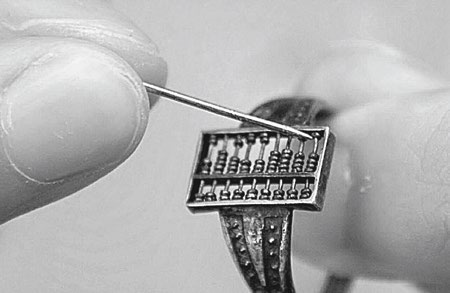
Abacus ring from Qing Dynasty in the Abacus Museum in Huizhou
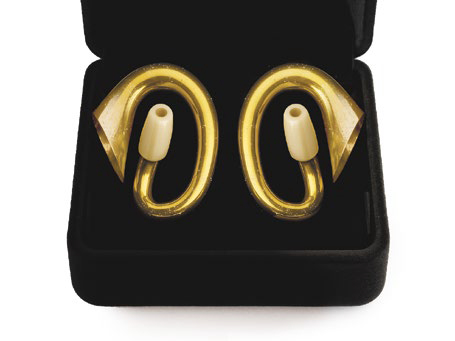
AI Illustration of a pair of miniature brass ‘bugle’ ear trumpets invented by Jean Pierre Bonnafont (1805–1891)
It was with the arrival of electricity, towards the end of the 1800s and the beginning of the 1900s, that the first electronic hearing aids were developed, based on microphones and amplifiers.
Still, the true story of wearables designed to minimise technology by integrating it into the human body begins at the Massachusetts Institute of Technology in the 1960s. Nothing surprising there. What better place than MIT? The surprising part is that the wearables invented by professor of mathematics Edward Thorp and his colleague Claude Shannon between 1960 and 1961 were not intended to make life easier or to improve physical wellbeing, but rather to cheat at roulette.
These were computerised timing devices. As Thorp would later write in Beat the Dealer, the device gave the wearer an advantage over the house. Eleven years later came George, a minicomputer hidden in the heel of a shoe, created to gain an edge in blackjack. It was invented by Keith Taft, who ended up losing $4,000 in a single evening. George was soon retired, although between the 1960s and 1970s, various versions of the device were developed, to the delight of computer enthusiasts passionate about miniature integrated circuits.
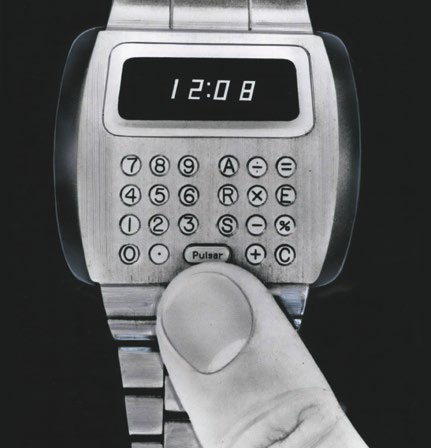
Pulsar Time Computer, 1972
The result was Pulsar, a calculator-watch advertised as “for the man who has everything”. The limited-edition price was around $4,000. It became one of the first examples of wearable technology available to the public, although certainly not affordable to all.

Steve Mann: 1970s lightspacer with 1981 wearcomp.
For several decades, at least in terms of what was commercially available, the rest was left to the imagination of cinema, while scientists, inventors and computer engineers continued working quietly in their laboratories. If the Google Glass, presented in 2017, bring to mind the visors worn by Arnold Schwarzenegger in RoboCop, released in 1984, already in 1981 American student Steve Mann had connected a head-mounted camera to a 6502 computer, the same processor used in the Apple I and Commodore 64.
The camera captured images that were processed in real time by the computer and sent to the visor, which could overlay them on reality. This anticipated the basic concepts of augmented reality. It was one of the earliest examples of wearable computing, and one of the first experiments in cyborg vision, that is, the enhancement of visual perception through technology.
From that moment on, the story stops being history and wearable technology steps into our present.
Copyright © Homa 2026
All rights reserved