












A refrigerator does not use one fixed amount of current under all operating conditions. The actual electrical demand depends on the model, rated voltage, frequency, compressor operation, defrost cycle, and other design factors. Therefore, there is no single amp value that applies to every refrigerator or every market.
For accurate information, users should check the appliance nameplate, technical specification sheet, or product manual. The Rated Current or Input Current is normally the most useful value for understanding the appliance’s specified electrical requirement. If only rated power and voltage are available, current can be estimated using the relationship between power and voltage, but this should be treated as an approximate value rather than a replacement for the manufacturer’s rated current.
As a refrigeration manufacturer, Homa Appliances provides refrigerator solutions for different markets and electrical requirements. Understanding the difference between rated current, operating current, and starting current helps buyers evaluate refrigeration products more accurately.
What Does Refrigerator Current Mean?
Current refers to the amount of electrical flow used by an appliance and is measured in amperes, or amps (A). A refrigerator’s current is not necessarily constant because the compressor and other electrical components operate in cycles.
The Rated Current is the current value specified by the manufacturer under defined rated operating conditions. This is the value buyers should normally use when reviewing the electrical requirements of a refrigerator.
The current measured during actual operation may change. When the compressor is running, the refrigerator may draw current according to its operating conditions. When the compressor stops, the current demand can decrease. Other components, such as the defrost system, can also change the appliance’s electrical demand during certain operating cycles.
Starting current is another consideration. When a compressor starts, it may briefly draw more current than its normal operating or rated current. This short-duration increase is different from the refrigerator’s rated current and should not be used as the same value.
How Can You Find Out How Many Amps a Fridge Uses?
The most reliable way to determine refrigerator current is to check the product’s nameplate. Depending on the market and product design, the label may list information such as rated voltage, frequency, rated current, input power, or other electrical specifications.
For example, a refrigerator may be marked for a specific voltage and frequency combination, such as 220–240 V and 50 Hz. The current specification should always be considered together with the rated voltage and frequency because electrical requirements can differ between markets.
If the nameplate does not provide a current value but gives rated input power and voltage, users can use Power ÷ Voltage as a rough estimate of current. For AC refrigerators, however, the actual current can also depend on power factor and other electrical characteristics.
For example, 180 W ÷ 230 V gives a simple power-to-voltage estimate of approximately 0.78 A. For an AC refrigerator, however, this figure should not be treated as the actual rated current because power factor and other electrical characteristics can affect the current.
Actual electrical characteristics can be affected by factors such as power factor, compressor design, operating conditions, and the type of electrical system. When a manufacturer’s Rated Current or Input Current is available, that value should be used instead.
Why Voltage and Market Matter
A refrigerator cannot be assigned one universal current value without considering its electrical configuration. The same product family may be produced for different markets with different rated voltage and frequency requirements.
For this reason, buyers should not compare amp values without checking the corresponding voltage and frequency. A current value specified for a 220–240 V, 50 Hz configuration should not automatically be applied to a different electrical configuration.
This is particularly important for international appliance businesses. When selecting products for different markets, customers need to confirm the electrical specifications of the exact configuration being supplied. Voltage, frequency, rated current, input power, plug requirements, and applicable standards may all need to be considered.
How Much Current Does the FN2-65 Refrigerator Use?
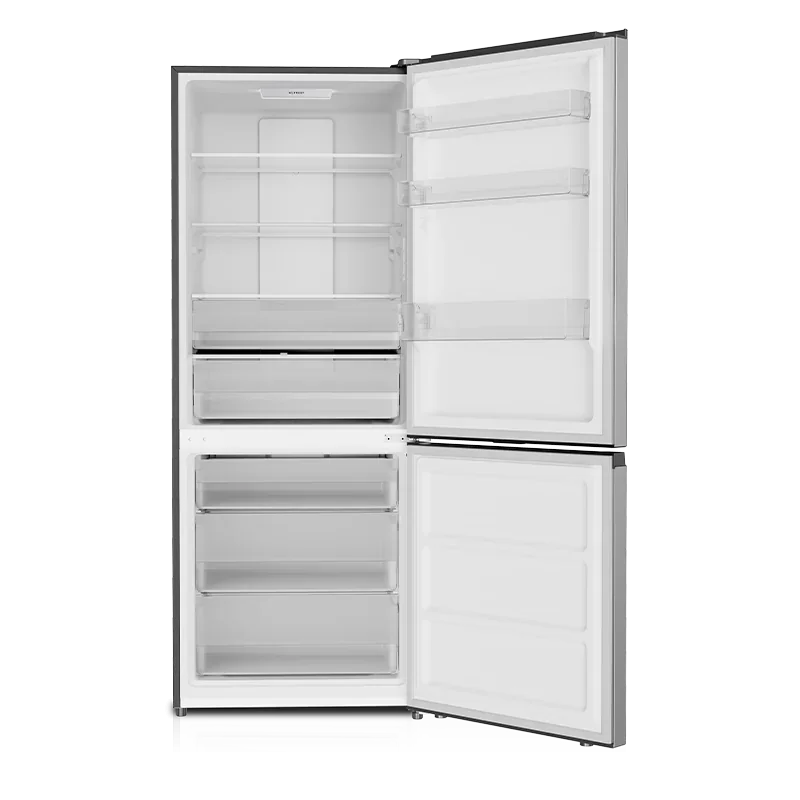
For the 220–240 V, 50 Hz configuration of the FN2-65 refrigerator-freezer, the rated current is 1.5 A. The appliance has a rated input power of 180 W and a defrost power of 180 W.
The 1.5 A figure is the manufacturer’s rated current for this specified electrical configuration. It should not be interpreted as a constant current draw throughout the entire operating cycle.
Actual current draw may vary during operation as the compressor and defrost system cycle on and off. The refrigerator may therefore have different electrical demand at different points in its operating cycle.
The rated current should also be considered together with the product’s rated voltage and frequency. For the FN2-65 configuration discussed here, the relevant electrical specification is 220–240 V and 50 Hz. Customers ordering products for other markets should confirm the electrical configuration and technical specification for the version intended for that market.
Does Refrigerator Capacity Determine Current?
Refrigerator capacity can influence the design and cooling requirements of an appliance, but capacity alone cannot be used to calculate its current.
A larger refrigerator does not automatically have a specific amp requirement simply because it has more storage space. Compressor type, insulation, cooling system, temperature control, energy efficiency, defrost design, and other technical factors can all influence electrical demand.
For this reason, buyers should not estimate current only from refrigerator capacity. A 500-liter refrigerator and another refrigerator with a similar capacity may have different rated currents because their refrigeration systems and electrical designs are different.
Technical specifications provide a much more reliable basis for comparison than capacity alone.
Understanding Rated, Operating, and Starting Current
These three terms should be kept separate when discussing refrigerator electricity use.
Rated current is the manufacturer’s specified current under defined rated conditions. It is the key figure to check when reviewing the appliance’s electrical specification.
Operating current refers to the current drawn while the refrigerator is actually operating. It can change as the compressor and other components cycle.
Starting current is the short-duration current drawn when the compressor starts. It may be higher than the normal operating or rated current, but it only occurs for a short period.
Defrost operation can also affect current demand. When the automatic defrost system operates, the electrical load may differ from normal compressor operation. Therefore, a refrigerator’s electricity use should be understood as a changing operating process rather than one constant amp value.
Making a More Accurate Refrigerator Selection
So, how many amps does a fridge use? The answer depends on the specific model and its electrical configuration; the manufacturer’s rated current is the appropriate value to use.
The best approach is to check the refrigerator’s nameplate, technical specification sheet, or product manual for the Rated Current or Input Current. If only power and voltage are available, current can be approximately estimated by dividing power by voltage, but the result should not replace the manufacturer’s specified current.
For the 220–240 V, 50 Hz configuration of the FN2-65 refrigerator-freezer, the rated current is 1.5 A, with a rated input power of 180 W and a defrost power of 180 W. Actual current draw can change as the compressor and defrost system operate in cycles.
By checking the exact electrical configuration and using manufacturer-provided specifications, appliance buyers can make more accurate decisions for household applications and different international markets. Homa Appliances continues to develop refrigeration products with attention to practical storage requirements, technical specifications, and market needs.