












Choosing a freezer requires more than looking at storage space. Buyers often consider service life, energy use, maintenance needs, and product structure before making a decision. In general, an upright freezer can often provide around 10–15 years of service when it is properly used and maintained. However, the actual lifespan may vary depending on operating environment, usage frequency, maintenance practices, and product design.
Understanding these factors can help users make more informed choices when selecting refrigeration products. As a refrigeration manufacturer, Homa Appliances studies market needs and develops products that support different household and commercial requirements through manufacturing experience and design knowledge.
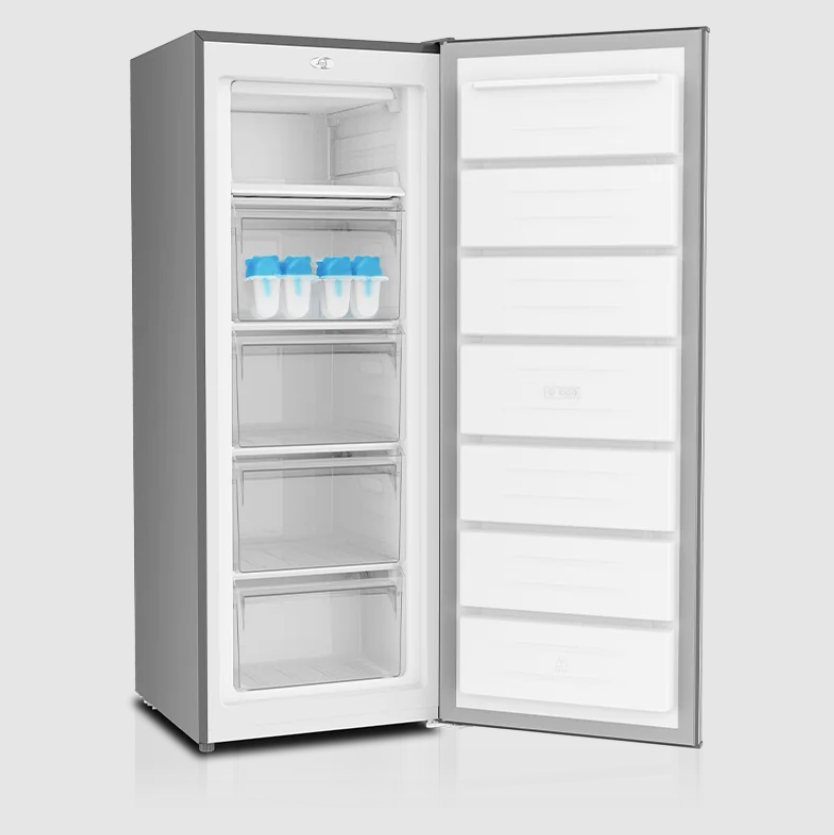
Factors That Influence Upright Freezer Service Life
The lifespan of an upright freezer depends on several practical conditions. Compressor performance, insulation materials, door sealing, and temperature control systems all affect long-term operation. A freezer used in a stable environment usually has fewer operation challenges than one exposed to frequent temperature changes.
Daily usage habits also influence product durability. Opening the door many times, placing warm food inside, or blocking airflow can increase the workload of the cooling system. Regular cleaning and proper placement help maintain normal performance during daily use.
Manufacturing processes also play an important role in freezer reliability. Production control, component selection, and inspection procedures affect the final product quality. Through years of refrigeration manufacturing, our company focuses on product development and production management for global customers.
Understanding How Long an Upright Freezer Lasts Through Maintenance
Maintenance is an important part of extending freezer service life. Users should keep the interior clean, check door seals regularly, and avoid unnecessary temperature adjustments. These simple steps can reduce pressure on the cooling system and support stable operation.
The surrounding environment also matters. A freezer placed in a well-ventilated area can release heat more effectively. Keeping space around the appliance allows the cooling components to work in a suitable condition.
Energy efficiency is another factor connected with product usage. Modern freezers are designed with different energy classes and technologies to meet regional market requirements. Buyers should select products based on their actual needs, storage habits, and local standards.
How Product Design Affects Freezer Performance
The design of an upright freezer involves storage layout, temperature management, and user convenience. Different markets may require different sizes, capacities, and appearance styles. Manufacturers need to consider these factors when developing products for international customers.
An upright freezer usually provides vertical storage space, which makes organisation easier compared with some horizontal freezer types. Shelves, compartments, and internal structures help users arrange different food categories. Good design can improve the daily experience without adding unnecessary complexity.
For businesses that purchase refrigeration products, ODM cooperation can provide more flexibility. Homa Appliances works with international partners to develop refrigeration products according to market requirements. The process involves product design, manufacturing coordination, and quality management.
Exploring Storage Capacity and Configuration Options
Capacity selection is connected with household size and storage demand. A smaller freezer may fit limited spaces, while larger models can support users who need more frozen food storage. Buyers should compare dimensions, internal capacity, and installation space before selecting a suitable upright freezer.
The DE1-21N upright freezer demonstrates how compact dimensions can be combined with practical frozen storage. It has a height of 143 cm, a width of 55 cm, and a depth of 57 cm, providing a total net freezer capacity of 168 liters. Its vertical design helps organize frozen foods while making efficient use of floor space.
The DE1-21N is available with New European Energy Class F, E, and D, together with a 4-star freezer rating, allowing distributors and appliance brands to select configurations that meet different regional market requirements. Understanding product dimensions, storage capacity, and energy performance helps buyers choose freezer solutions that match their application needs.
Practical Knowledge Behind Upright Freezer Service Life
There is no single service period that applies to every upright freezer because usage conditions are different. A product’s operating environment, maintenance routine, and manufacturing quality all influence its working life. Users can make freezers operate more consistently by following suitable care practices.
Many buyers ask how long does an upright freezer last when comparing different refrigeration options. The service life of a freezer depends on factors such as product design, usage conditions, and maintenance habits. Understanding these factors helps users make more informed choices when selecting refrigeration products.
For international appliance brands, choosing a reliable manufacturing partner is also an important step. A supplier with refrigeration experience can support product development, production planning, and market adaptation, helping brands create products that match different customer requirements.
Conclusion
Refrigeration technology continues to develop with changing consumer needs. Energy requirements, storage preferences, and kitchen designs influence how manufacturers create new refrigeration solutions. Understanding these trends helps companies develop suitable refrigeration solutions for different regions.
In global refrigeration markets, product selection often requires attention to transportation, installation space, and regional requirements. Manufacturers need to consider these factors during development. Clear product information, accurate specifications, and communication between partners can help improve cooperation efficiency. This also supports better planning from initial design to final production stages.
Our experience in refrigeration manufacturing allows us to provide customized product support for overseas partners. We focus on practical design, production management, and cooperation with global customers. Our goal is to support stable product development through professional manufacturing processes.
By understanding freezer structure, maintenance methods, expected service life, and capacity choices, buyers can make clearer decisions. Although an upright freezer typically lasts around 10–15 years, its actual lifespan depends on operating conditions, maintenance, and product quality.
Homa Appliances provides refrigeration manufacturing solutions and supports ODM projects with products such as the DE1-21N upright freezer. The combination of manufacturing experience and product knowledge helps meet different market needs.