











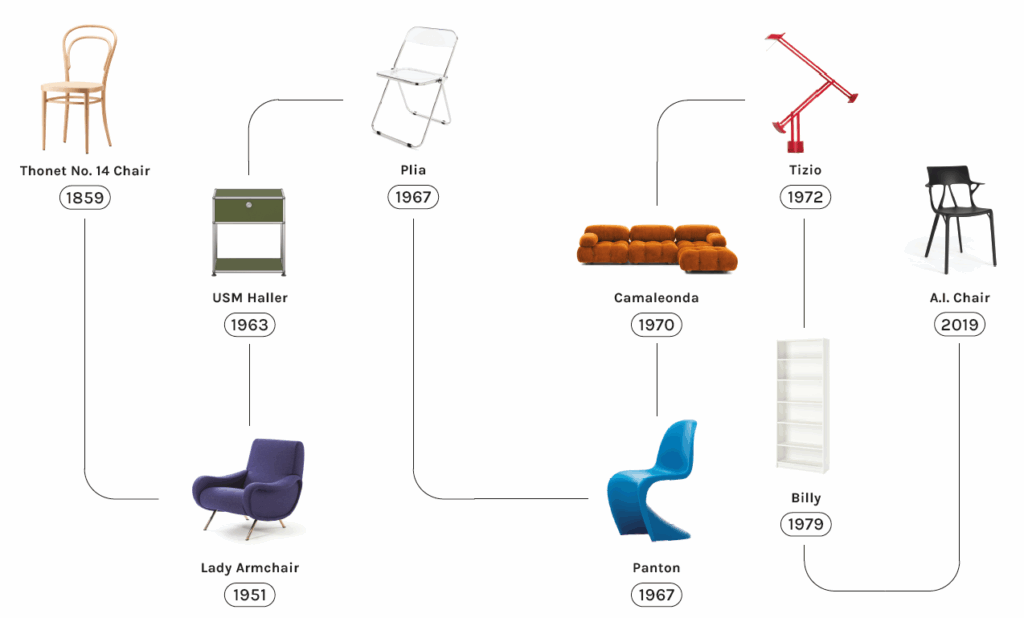
Some objects transcend their function as furniture to become cultural manifestos, redefining the way we live and interact with the world around us. This curated selection of nine icons traces the history of design through some of its most daring breakthroughs: from Michael Thonet’s pioneering mass production, mastering the art of steam-bent wood and inventing the very first flat-pack, to the industrial revolution of Marco Zanuso’s Lady armchair, the gravity-defying curves of the Panton Chair, and the democratic transparency of the Plia chair.
Each piece stands as a testament to the idea that true innovation arises when creative thinking disrupts established industrial processes, transforming technical constraints into groundbreaking opportunities. We explore systems that brought a new sense of order to the home, such as the modular precision of USM Haller and the global ubiquity of IKEA’s Billy bookcase, alongside the engineering mastery of the Tizio lamp and the modular fluidity of Mario Bellini’s Camaleonda, the true forerunner of contemporary modular seating.
This non-exhaustive journey culminates with Kartell’s A.I. chair, opening a new chapter where algorithms and human intuition collaborate to optimise both matter and form. These objects did more than challenge the laws of physics or market conventions; they offered a visionary answer to a timeless question: how can design truly enhance our daily lives?
Thonet: the chair that invented modern design
The No. 14 chair marks the precise boundary between elite craftsmanship and the birth of modernity. The world’s most famous bistro chair is the manifesto of a vision that learned to tame nature through the power of steam. Michael Thonet did not simply design a successful piece of furniture; he applied industrial logic to design before anyone else, and with remarkable effectiveness.
To bend wood, one must “outsmart” it or rather tame its two primary components: cellulose, which provides tensile strength, and lignin, which provides compressive strength. To manipulate this natural material, both components must first be softened. The secret lies in saturating the wood with pressurised steam. This process makes the cellulose more elastic and the lignin more pliable. Once the wood becomes ductile, it yields its resistance and can be bent along the direction of the grain. After drying, it returns to its original stability and strength, permanently retaining its new form. His true stroke of genius, however, which set him apart from every other cabinetmaker, was the introduction of a metal tension strap clamped to the wood during bending. This strap absorbed the tensile forces, preventing the outer fibres from shattering. Once dried in moulds, the wood regained its rigidity, permanently retaining its new and unmistakable silhouette.
Thanks to this patented technique, it was no longer necessary to rely on master craftsmen for complex individual pieces or small batches. Chairs, armchairs, tables and stools could finally be mass-produced. Thonet was the first to bring furniture manufacturing onto a truly industrial scale. The emblem of this revolution is the No. 14 chair, later renamed 214 to celebrate the first two centuries of its life. Produced in millions, it is widely considered the most successful industrial furniture product of all time.
It represents the “year zero” of modern furniture: a system of standardised parts in which nothing is superfluous. The backrest forms a continuous curve, while the reinforcing ring stabilises the legs, translating mechanical resistance into linear elegance.
As the first flat-pack product in history, the 214 rewrote the rules of global logistics. By replacing glued joints with simple screws, Michael Thonet was able to pack thirty-six disassembled chairs into a crate measuring just one cubic metre. From Vienna to Paris and across the Americas, the chair quickly began furnishing cafés in every corner of the world.
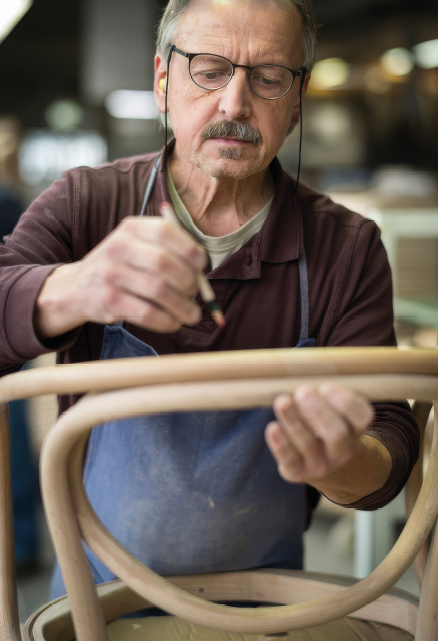
The wood used for the 214 chair comes from sustainably managed forests. Thanks to its exceptional quality, it is also extremely durable, and repairs can easily be carried out at any time.
©Philipp Thonet
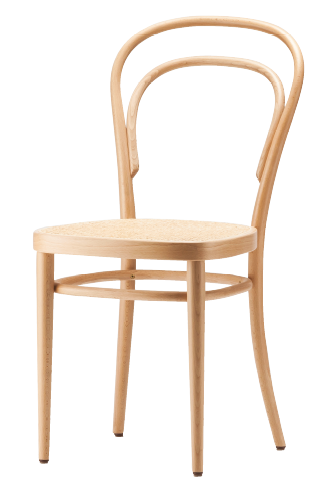
The longevity of a piece of furniture lies in its versatility.
Thonet’s functional design moves naturally across different environments, from large-scale contract projects to the intimacy of residential spaces.
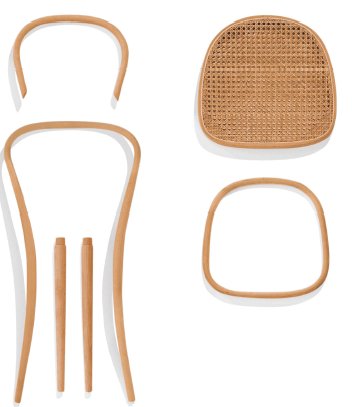
A disassembled Thonet: the original flat-pack archetype.
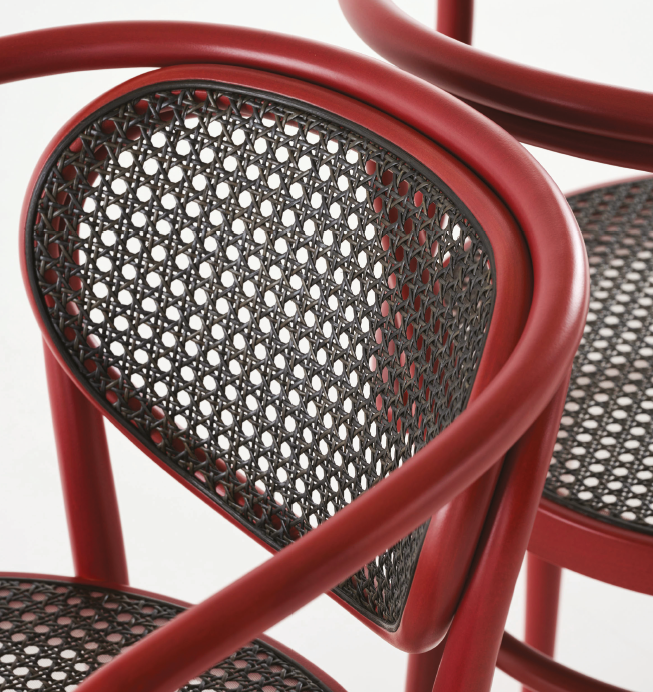
On the opposite page, a detail of the new Dark Melange canework designed by the young designer Jan Christian Schulz.
The Timeless Diva
The story of the Lady armchair, designed by Marco Zanuso in 1951, marks the birth of modern industrial design in Italy: a technological revolution that brought automotive innovation straight into the living room.
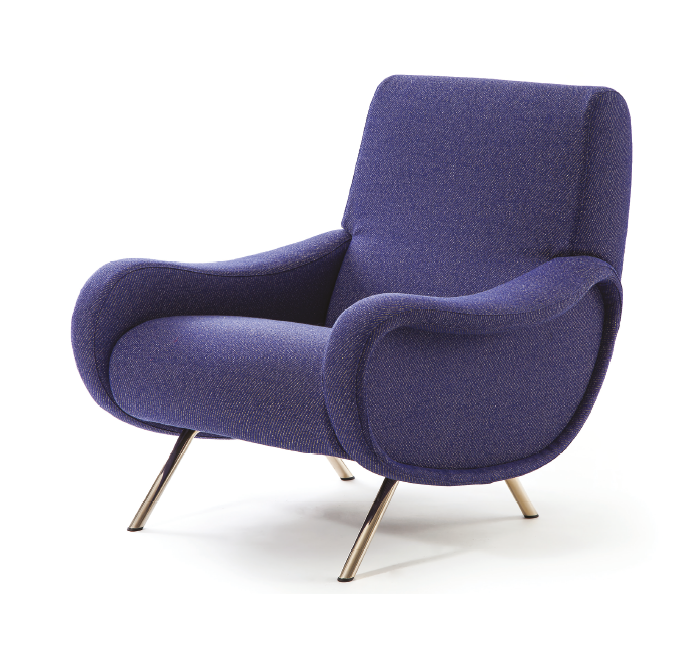
It all began in 1948 when Pirelli approached Marco Zanuso, a brilliant young architect, to explore the potential of new plastic materials for upholstery. While the Antropus chair was the first result of this research, it was with the Lady that Zanuso perfected a radical new approach to furniture production. Until then, armchairs were made using traditional handcrafted methods: wooden frames, jute webbing and horsehair, making production slow and expensive.
Zanuso realised that Pirelli’s new elastic, mouldable materials such as foam rubber and expanded polyurethane could fundamentally transform the entire manufacturing process. Instead of shaping the padding directly onto a finished frame, the individual components, seat, backrest and sides, could be manufactured and upholstered separately before being assembled onto an internal skeletal structure.
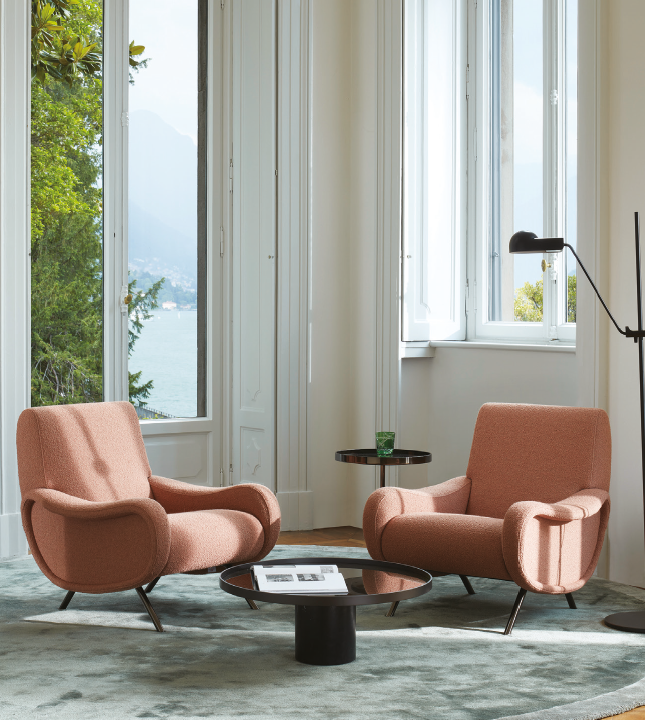
Originally designed for Arflex, the Lady armchair was reissued in 2015 by Cassina within the I Maestri collection.
©De Pasquale+Maffini
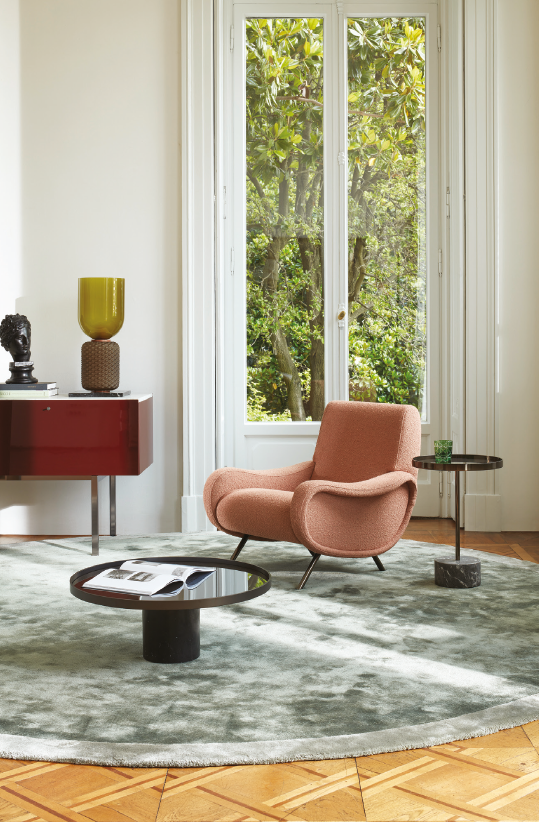
Beyond its aesthetics, there is more: the Lady armchair pioneered the use of elastic suspension in upholstered furniture thanks to its system of reinforced elastic straps.
©De Pasquale+Maffini
The use of foam rubber turned suspension and padding into a single, unified system, transforming the armchair from a collection of handcrafted parts into a true industrial product.
This was the assembly-line principle, borrowed by Zanuso from the automotive industry. A suspension system of reinforced Nastrocord elastic straps ensured a superior level of comfort. This new manufacturing method allowed each element of the chair to have a different padding density, precisely calibrated to the pressure the body exerts on different parts of the seat. Beyond providing unprecedented comfort, this technique drastically simplified mass production, marking furniture’s decisive entry into the industrial age.
The Lady was the first armchair produced using a serial moulding process, reducing labour time while achieving a level of precision beyond the reach of traditional upholstery. Presented at the IX Milan Triennale in 1951, it immediately won the Gold Medal, becoming the symbol of modern comfort and of Italy’s post-war industrial rebirth.
Today, produced by Cassina as part of the prestigious I Maestri collection, it is part of the permanent collections of some of the world’s greatest museums, including MoMA in New York. Over its seventy-five-year history, the Lady has reinvented itself many times, from sophisticated velvets to bold textures, through a constant evolution of materials.
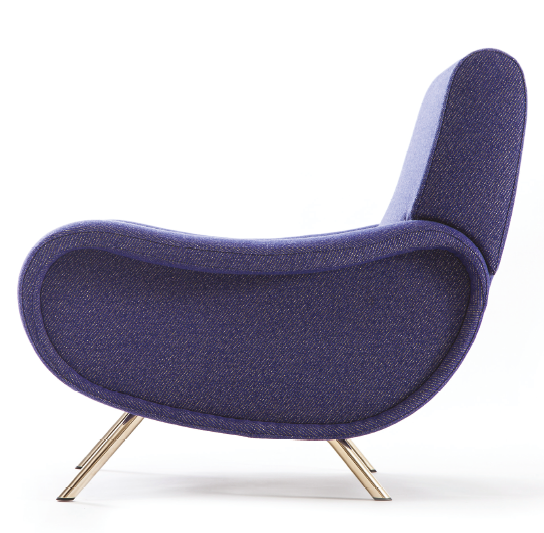
A wide range of fabric and leather coverings enhances the beauty and comfort of this enduring icon.
©Courtesy Cassina
USM Haller: Architecture as a Modular System
The iconic Modular System, originally created for the offices of a Swiss company, has evolved into a global symbol of efficiency and rationality. Its uniqueness lies in its open architecture, a system defined by an unprecedented inverse scalability that defies obsolescence through total compatibility between past and future.
In 1961, Paul Schärer, grandson of USM’s founder, decided to transform the family’s hardware factory into a modern industrial powerhouse. To do so, he commissioned Swiss architect Fritz Haller to design the new production plants and headquarters in Münsingen, Switzerland. Haller delivered a modular architecture based on steel frames, a flexible system capable of expanding according to the company’s needs.
The partnership deepened in 1962 when Haller and Schärer began developing an office furniture system based on the same principles of modularity and versatility as the new building. It was furniture conceived not as individual pieces, but as a system of adaptable and reconfigurable steel modules.
The heart of the system is the elegant and ingenious ball joint, patented in 1965. Its six threaded holes allow chrome tubes to be connected in three directions, creating a lattice structure onto which painted metal panels are snapped. The result is a system without a fixed form, ready to evolve over time.
This open-ended approach transcends the concept of obsolescence. Every component produced today is technically identical and fully compatible with those from sixty years ago, turning the manufacturing process into a virtuous and continuous flow.
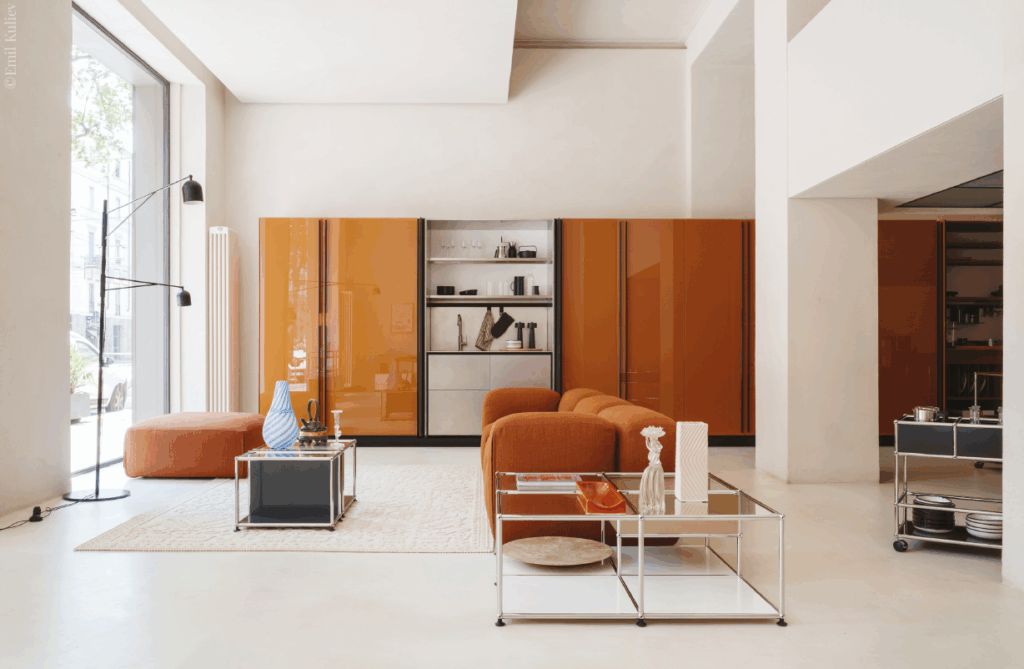
For the first time, a company developed not only the product, but also the logic of assembly and disassembly. A unit can be dismantled and reassembled into a different configuration without losing structural rigidity, which is nothing short of an engineering miracle. This process innovation shifts the product’s value from physical ownership to its potential for transformation. You are not buying a finished piece of furniture, but the industrial capacity to reshape your space whenever necessary.
Originally intended for exclusive use within USM offices, the system caught the attention of the Rothschild Bank in Paris, which ordered 600 workstations in 1969. This marked the beginning of mass production and the global rise of USM Haller as a world-renowned furnishing system.
“I never designed a furniture system. I designed construction systems for entire buildings, and the USM Haller system is simply the miniature version of that structural idea”
Fritz Haller
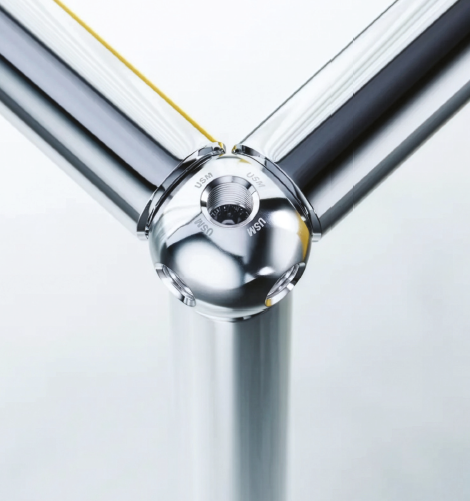
A close-up of the elegant, ingenious ball joint, patented in 1965
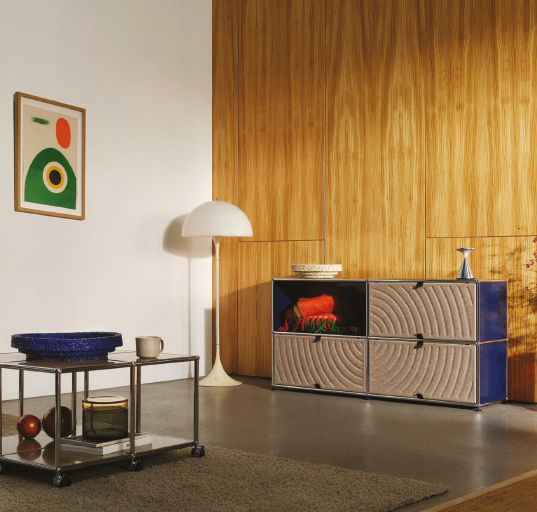
On the opposite page, USM Haller modules at the Spotti showroom in Milan, ©Emil Kuliev
In 2001 it entered the permanent collection of MoMA in New York as a true construction system. To this day, every USM piece is meticulously crafted at the historic Münsingen plant, just outside Bern, Switzerland. Here, production is an art form governed by an uncompromising commitment to safety, energy efficiency, and near-total recyclability at every stage. The state-of-the-art powder-coating process is entirely solvent-free and devoid of heavy metals, ensuring that beauty never comes at an environmental cost. A pioneer in sustainability, USM was awarded Greenguard certification in 2008 and the prestigious Cradle-to-Cradle® mark in 2018, milestones on its ambitious journey toward becoming a 100% circular enterprise by 2030.
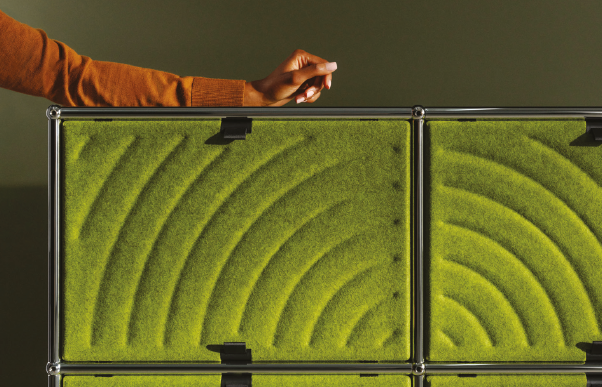
The new USM Haller Soft Panel introduces a soft, playful dimension to the USM product line.
To celebrate the system’s 60th anniversary, the company released a lookbook featuring 100 original configurations, a testament to its inexhaustible versatility: custom wardrobes, nursery furniture, home office solutions, vinyl storage, and domestic bar units. Every configuration is an exercise in creativity that reflects the essence of the system: modular freedom, durability, and essential beauty. The collection’s most recent evolution introduces the USM Haller Soft Panel: these thermoformed polyester felt panels are designed to optimize acoustic performance, merging structural precision with a new sense of softness.
Plia: The Vanishing Chair
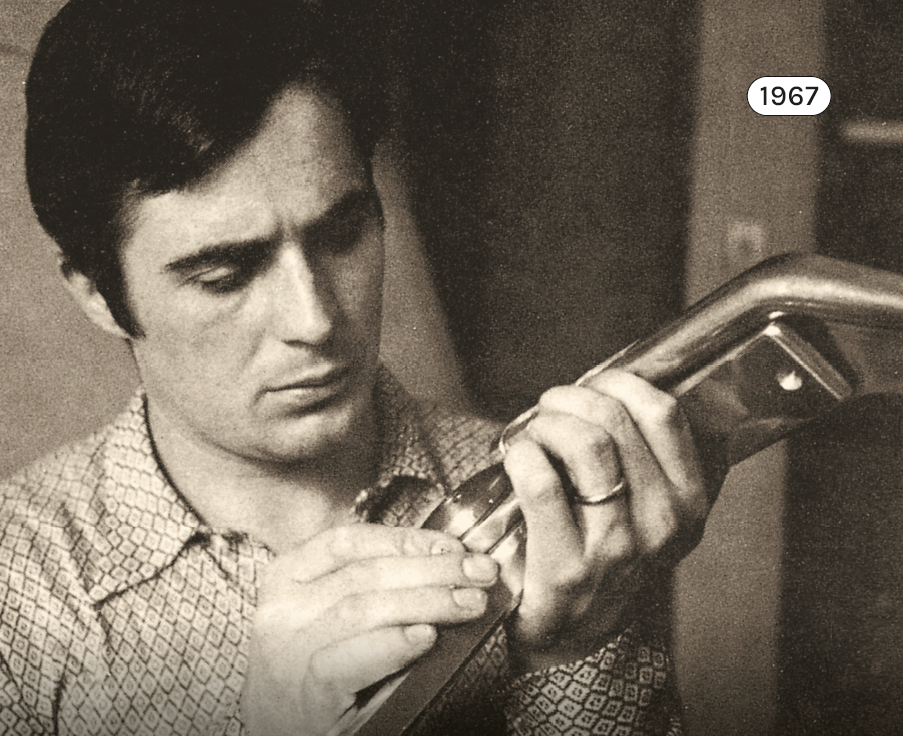
How three steel discs and a sheet of plastic redefined democratic design and the art of saving space.
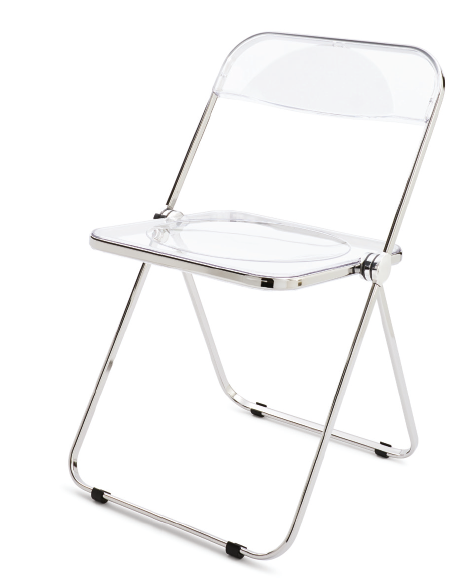
Before Plia, folding chairs were often clumsy and purely functional. Then came Giancarlo Piretti’s stroke of engineering brilliance: a lightweight alloy joint made of three interlocking steel discs that allow the frame to fold with remarkable precision.
«I was asking myself very simple questions», Piretti recalls. «How can I make a chair transparent? Can it be foldable and yet incredibly slim?».
The answer lay in a material typical of the era: Cellidor, a cellulose acetate originally used for luxury sunglass frames. Once reinforced and refined, it became the first transparent plastic used structurally in furniture design.
“Objects are usually chosen for their aesthetic impact. People look at the style first, and only then consider whether it is comfortable. The Plia was designed for sitting an hour or two at most, but in the end people choose with their eyes and not with their backsides”
Giancarlo Piretti
When it was unveiled at the Salone del Mobile in Milan by Anonima Castelli, Plia left the industry speechless. It was light and unobtrusive and, thanks to its clear Cellidor seat, seemed to float in mid-air. The enthusiasm of the crowd was so overwhelming that by the end of the first day several prototypes had vanished from the booth, carried off by visitors fascinated by its ingenious mechanism and the novelty of transparent plastic.
However, when Anonima Castelli attempted to launch the chair in the United States, they encountered an unexpected obstacle: American consumers were not accustomed to such radical transparency. «From that day on I felt that marketing is the enemy of designers, at least for me», says Piretti. «It took years for it to catch on, but eventually it enjoyed enormous success in America».
Once that initial scepticism faded, Plia became an object of desire for urban dwellers, for whom every inch of space was precious. Its clean aesthetics made it a staple of high-fashion photography and avant-garde homes of the 1970s.
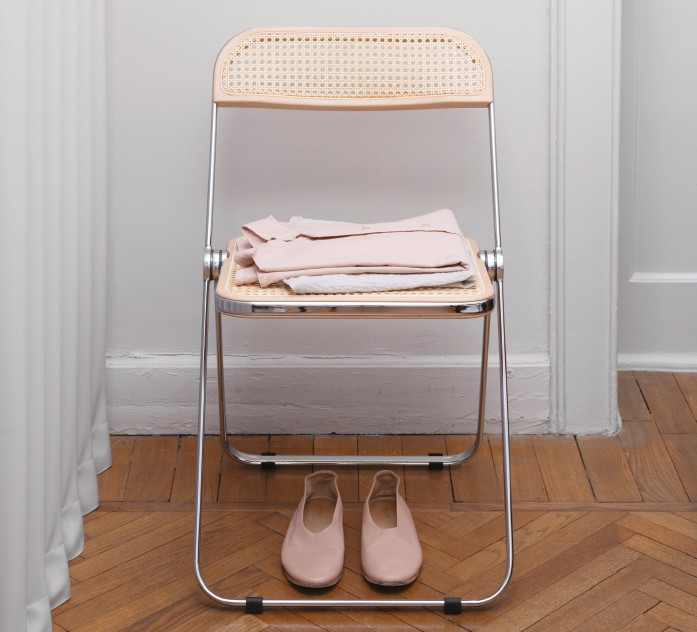
Plia has never been a showy icon. It has remained discreet, almost anonymous, as if its strength lay in being used, lived with and shaped by time.
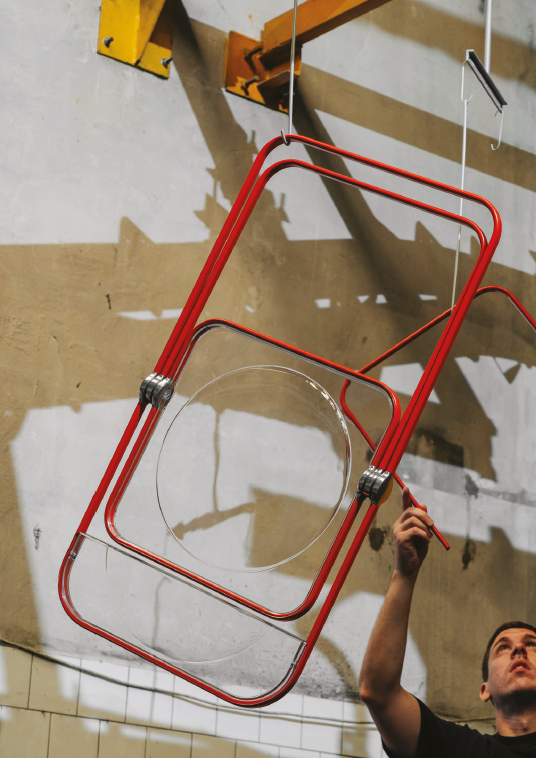
Its ultimate recognition came with its inclusion in the permanent collection of MoMA in New York, where it was celebrated as a landmark of functional Italian design.
In the 1980s minimalism turned it into an icon. Mila Schön ordered thousands for her runway shows. The 1990s and 2000s saw its popularity rise again as transparency became an increasingly important architectural theme.
Today Plia is a global classic seen in millions of homes, from modern kitchens to refined studios. It proves that when a mechanical intuition is flawless it becomes timeless. Its true strength lies in what might be called its “technological humility”: transforming the mundane act of folding a chair into a moment of pure engineering elegance, bringing a new sense of freedom to living spaces worldwide.
Copyright © Homa 2026
All rights reserved