












A pioneer of kinetic art and a master at redefining space through its interaction with the body, Gianni Colombo created immersive environments in constant transformation, foreshadowing the language of the Metaverse long before its time. His installations changed as the viewer moved, transforming spectators into active participants in a new, fluid sensory experience.
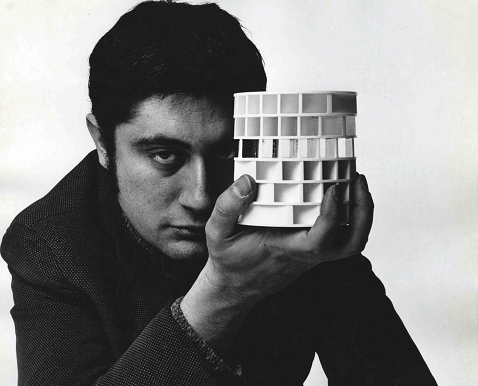
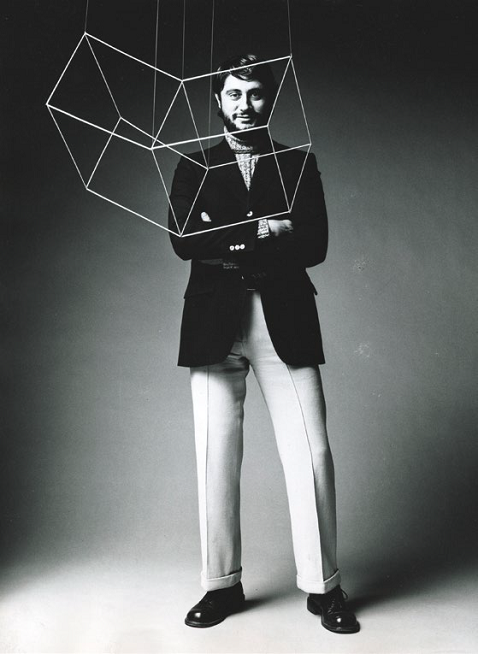
Portrait of Gianni Colombo with one of his “Strutturazione Acentrica”, captured by world-renowned photographer Oliviero Toscani.
Strutturazione Acentrica is a cylindrical structure encasing a beehive-like core made of parallel diaphragms aligned on a horizontal axis, layered vertically with varying angles of inclination. When the cylinder spins at high speed, light filters through the layers, producing the illusion of a rhythmic, vertical motion—an optical oscillation that evokes both ascent and descent.
While Joe Colombo entered the history of Italian design as one of the most creative and experimental designers of the 1960s, his brother Gianni was no less revolutionary in redefining artistic paradigms and anticipating new conceptual territories. At a time when 3D and interaction were exclusively physical, and virtual reality was still confined to science fiction, Gianni Colombo explored space in depth, leaving us with movement as a symbol of change, against standards, conventions and routine. The two brothers worked in adjacent studios for nearly a decade until Joe’s death in 1971. Together they created a single design object: the Acrilica lamp, designed in 1962 for O-luce and awarded at the XIII Triennale di Milano, where the light literally bends into a “C”, standing for “the Colombo brothers”.
The role of the observer, transformed from passive viewer to co-creator of the artistic experience, redefines aesthetics through new sensory and participatory dimensions.
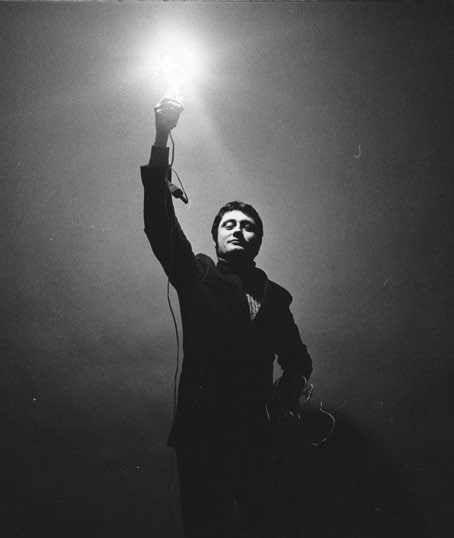
Gianni Colombo envisioned environments capable of triggering and stimulating both sensory and behavioural responses. These were spaces of total immersion, where the visitor was no longer a passive viewer, but an active participant within unfamiliar settings. His signature was transformation: his installations shifted based on the viewer’s position, the audience’s direct interaction, or internal mechanisms that generated movement. The aim was to break with the tradition of static, two-dimensional art and create immersive experiences that altered spatial perception, long before VR headsets even existed. Colombo rejected the fixed perspective of Renaissance tradition in favour of dynamic and mutable spatial configurations that could not be grasped from a single point of view. His works fall within kinetic art, a movement focused on motion, perception and the relationship between the work and the viewer.
As a leading figure of the Italian collective Gruppo T, active during the 1960s, Colombo experimented with light, space and motion. The “T” stood for “time”, understood as an element evolving in relation to the environment. Colombo’s artistic language questioned the security of habit, revealing just how fragile our sense of stability can be. Through geometric forms, bursts of light, reflective surfaces and modular structures, his installations disrupted everyday reference points, drawing viewers into environments that challenged perception and subverted expectations.
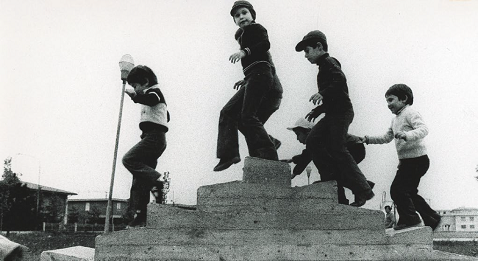
Bariesthesia: by disrupting the repetitive order and constant slope of the steps, evokes a form of tactile apprehension and kinesthetic response that unfolds through the sequential act of walking up or down the staircase.
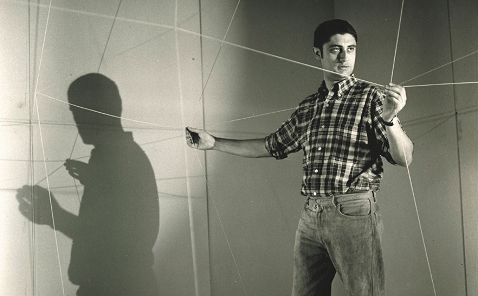
Gianni Colombo interacts with the installation, revealing how its elements respond and relate to one another.
SPAZIO ELASTICO
The illusion in motion that challenges perception
Spazio elastico is one of the most iconic works of Italian kinetic art. First presented in 1967 at Trigon 67 in Graz, Austria, the installation earned widespread acclaim, including a showing at the 1968 Venice Biennale, where it won the First Prize for Painting, and later at Documenta 4 in Kassel the same year.
The work consists of a completely dark cubic room crossed by fluorescent elastic cords arranged in an orthogonal grid. The immersive effect is powered by black elastic wires lit by Wood lights and moved by electromechanical motors. The result is an unstable, ever-changing space in which the grids continuously distort. Spatial coordinates appear to float, and anyone inside loses fixed reference points, confusing vertical with horizontal.
Gianni Colombo employed industrial materials and cutting-edge technology for the time, integrating scientific and technical elements into his artistic practice with a clarity that anticipated many future developments in interactive artistic installations.
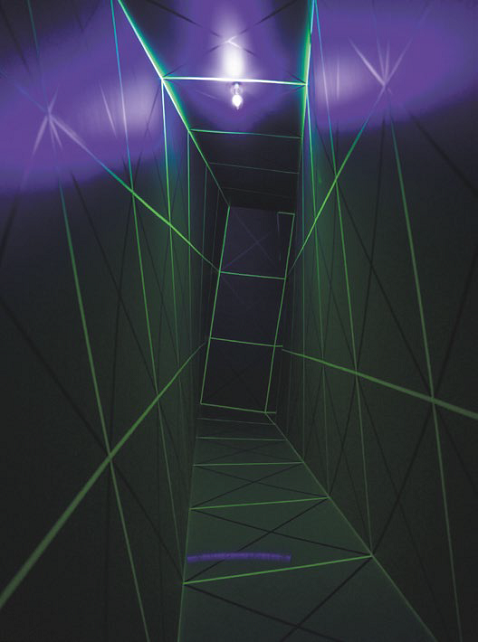
Spazio elastico marked a turning point in contemporary art, anticipating themes of interactivity and perception that would become central to later artistic practices.
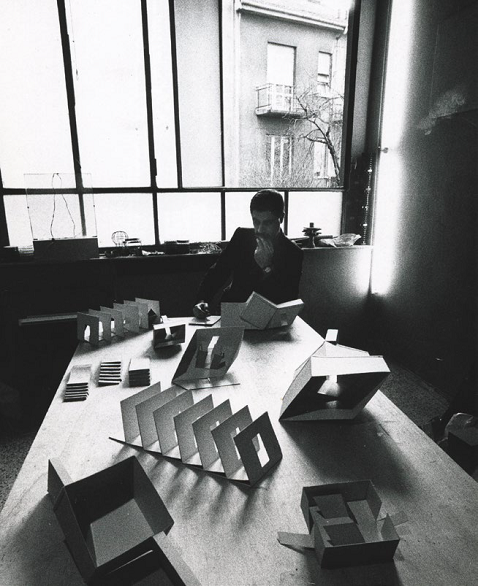
Gianni Colombo at work in his studio, 1977
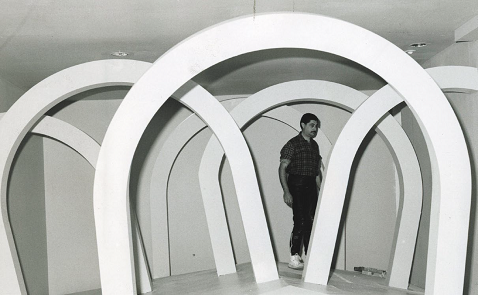
Cacogoniometric architecture installation
An immersive spatial experiment in which architectural elements—walls, staircases, and openings—are intentionally distorted, tilted, or displaced. The result is a state of disorientation, a breakdown of spatial logic, and a destabilized perceptual experience. These are not functional architectural spaces, but rather conceptual environments designed to engage the visitor both physically and psychologically.
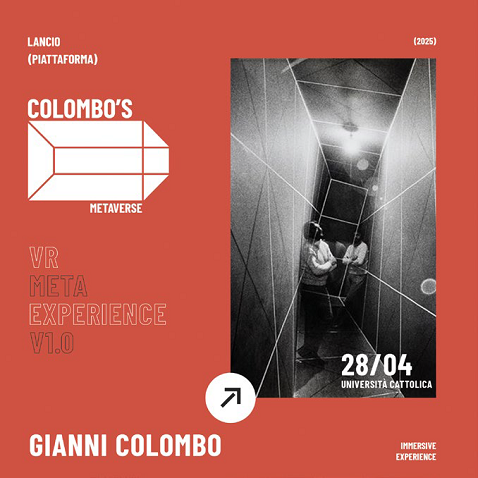
Colombo’s work can be seen as an analogue anticipation of the virtual world. Today, as his original installations face the inevitable wear of time, Colombo’s Metaverse has been developed to make these visionary works accessible to a wider public. These immersive environments were so ahead of their time that they still feel contemporary.
The project offers a way to experience his kinetic art even when the physical installations are no longer fully reconstructable. Many of his works now exist only as sketches, historical photographs or fragments that cannot be rebuilt. Colombo’s Metaverse is conceived as the natural continuation of his artistic journey, a body of work that explored the relationship between body and space in increasingly radical ways.
Colombo’s creations remain objects of study and admiration, bearing witness to his foresight and originality as one of the most visionary artists of the twentieth century. But his relevance does not end there. Colombo still speaks to us today, in a world where the relationship between body and space is constantly being redefined.
Supported by the Italian National Recovery and Resilience Plan (PNRR) through the Innovacultura grant, Colombo’s Metaverse reimagines his artistic legacy through innovation. It uses virtual reality to digitally reconstruct some of his most important works including Spazio Elastico, Spazio Curvo and Campo Praticabile, as well as key urban installations, allowing visitors to explore them in fully interactive three-dimensional environments.
Users can navigate this virtual landscape via computer or VR headset, encountering Colombo’s reconstructed works in a series of digital outdoor spaces. Several environments including Spazio Curvo, Spazio Elastico and Campo Praticabile, are housed within virtual rooms that visitors can enter to experience the same perceptual distortions originally conceived in analogue form. The project also includes the digital reconstruction of site-specific and architectural installations.
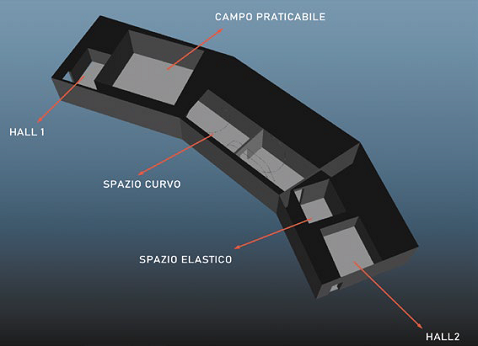
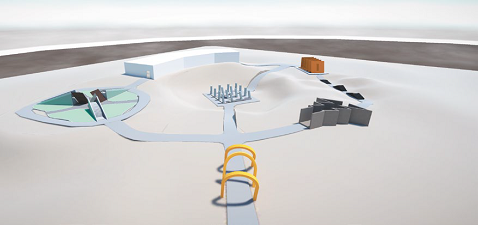
This ambitious initiative is carried out in collaboration with the Università Cattolica del Sacro Cuore in Milan, which is leading the analysis of how users perceive and respond to Colombo’s work in digital form. The goal is to collect data on user engagement, emotional impact and levels of understanding, to better grasp how kinetic art continues to move us, even in the virtual realm.
An initiative carried out with the contribution of the ERDF (European Regional Development Fund) Programme of the Lombardy Region
Spaces are rendered hybrid by shifts in perspective, and bodies remain balanced only when integrated with their environment.
Bio
Gianni Colombo
Gianni Colombo (Milan, 1 January 1937 – Melzo, 3 February 1993) was a leading figure in the field of kinetic art. Born in Milan, he was the younger brother of renowned designer Joe Colombo. His father Giuseppe ran a successful electrical manufacturing business, while his mother Tina played the piano, an instrument Gianni studied as well.
In 1959, together with Giovanni Anceschi, Davide Boriani and Gabriele De Vecchi, he founded Gruppo T, later joined by Grazia Varisco. The group sought to overcome traditional divisions between painting, sculpture and architecture, focusing instead on space, time and active viewer engagement.
In 1964, Colombo created his first immersive environment, Strutturazione cinevisuale
abitabile, shown at the Musée des Arts Décoratifs of the Louvre in Paris. This marked the beginning of his exploration of environmental installations designed to stimulate the viewer’s sensory and behavioural responses.
In 1985, he became director of the Nuova Accademia di Belle Arti in Milan, where he had taught Spatial Structuring since 1967. His career was marked by constant experimentation, culminating in works such as the Architetture Cacogoniometriche of the 1980s, in which architectural elements were digitally distorted through early computer modelling. Gianni Colombo died suddenly on February 3 1993 in Melzo’s hospital. His legacy continues through the work of the Gianni Colombo Archive, which promotes and preserves his artistic contributions.
Copyright © Homa 2026
All rights reserved